EXQUISITE NEW WORLDS
Week 6 Class Notes, 18 November 2019
First a note about tooth blackening. The material used to blacken teeth was called ohaguro. A description of it from the late 19th century describes it as a dye made by immersing heated iron scrapes in water and adding a small quantity of sake, and then mixing it with powdered gall-nuts. The court nobility had blackened their teeth since the Heian Period. During the Edo Period married women, courtesans and other prostitutes also blackened their teeth.
HOKUSAI
Personal Life
Hokusai had 3 children with his first wife, who died in 1794. He remarried in 1795 and had another son and at least one more daughter (O-Ei).
His first son, Tominosuke, is said to have been adopted as heir by the influential Nakajima Family (official mirror makers to the shogun) but died young about 1812.
His son from his second marriage was adopted by a minor government official, later taking over the government post himself.
Of his daughters by his first marriage, O-Miyo married Hokusai’s pupil Shigenobu around 1808 at the age of 19 but was divorced several years later. She returned home and died in her 20s, leaving a son who was taken in by Hokusai.
The other daughter, O-Tatsu, also died in her 20s. There is one painting known by her, signed “Ms Tatsu Hokusai’s daughter”.
O-Ei married the minor painter Tomei in about 1818. They divorced after some years (one source suggests 10 years).
In late 1820 Hokusai suffered from an unidentified medical condition that might have been a stroke and is sometimes described as palsy. He had difficulty drawing, but recovered.
In the 1820s Hokusai’s grandson became an incorrigible delinquent and source of trouble, racking up large gambling debts. He is thought to have banished this grandson from Edo in the late 1820s.
In 1828 Hokusai’s second wife died and O-Ei returned to live with Hokusai.
Print Artist
Hokusai left the Katsukawa school and joined the Tawaraya family in 1794 and then became an independent artist in 1798. The 1790s is the exact period that is known as the “golden age” of ukiyo-e, when wonderful prints of women were being produced by Utamaro (the most prolific) and others. By this period the oban size had been established as the standard for woodblock prints. Oban just means large and is not an exact measurement, but oban was generally at least 25 x 36 cm.
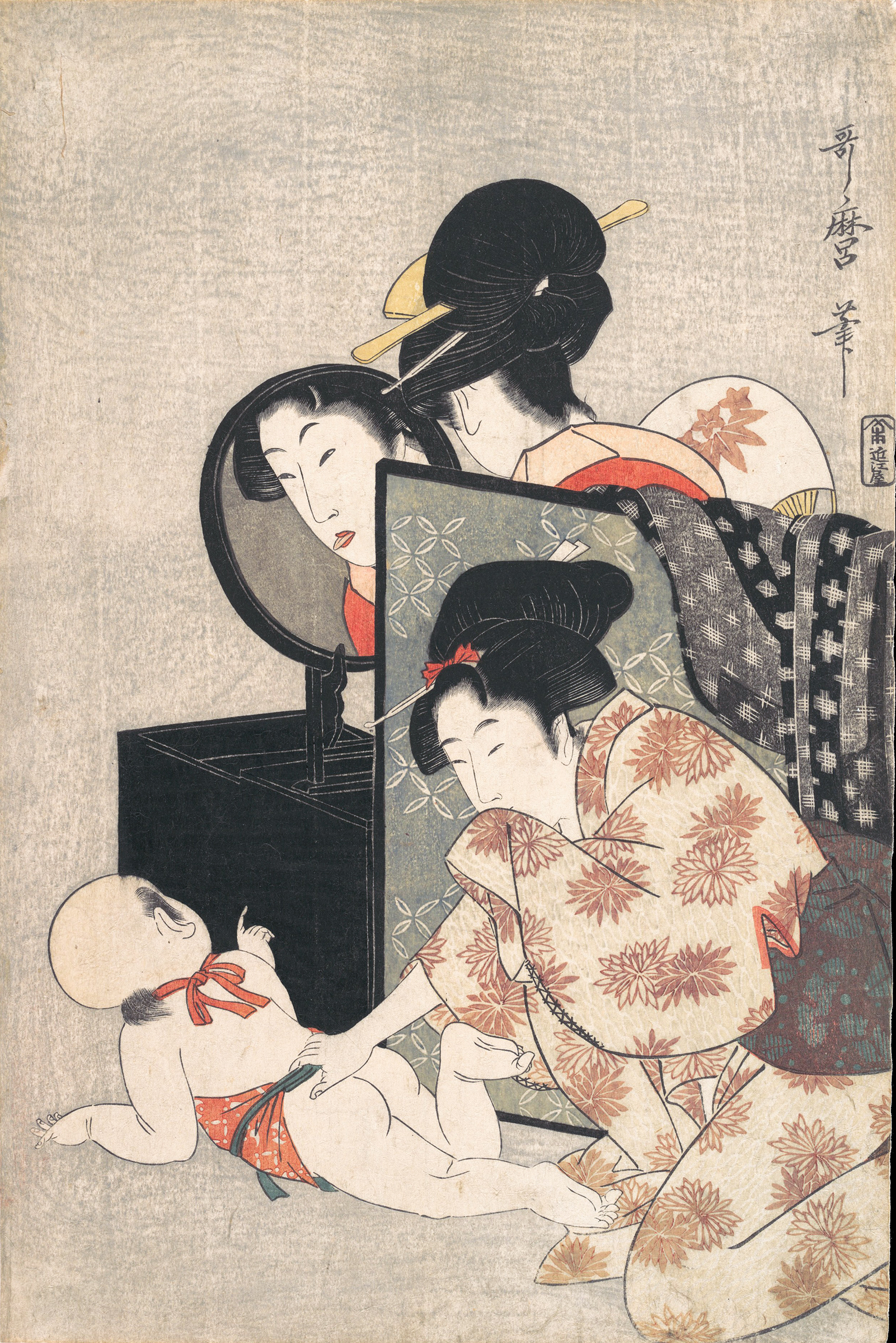
Women and Child
By Utamaro (1754-1806), c.1793
The MET, New York
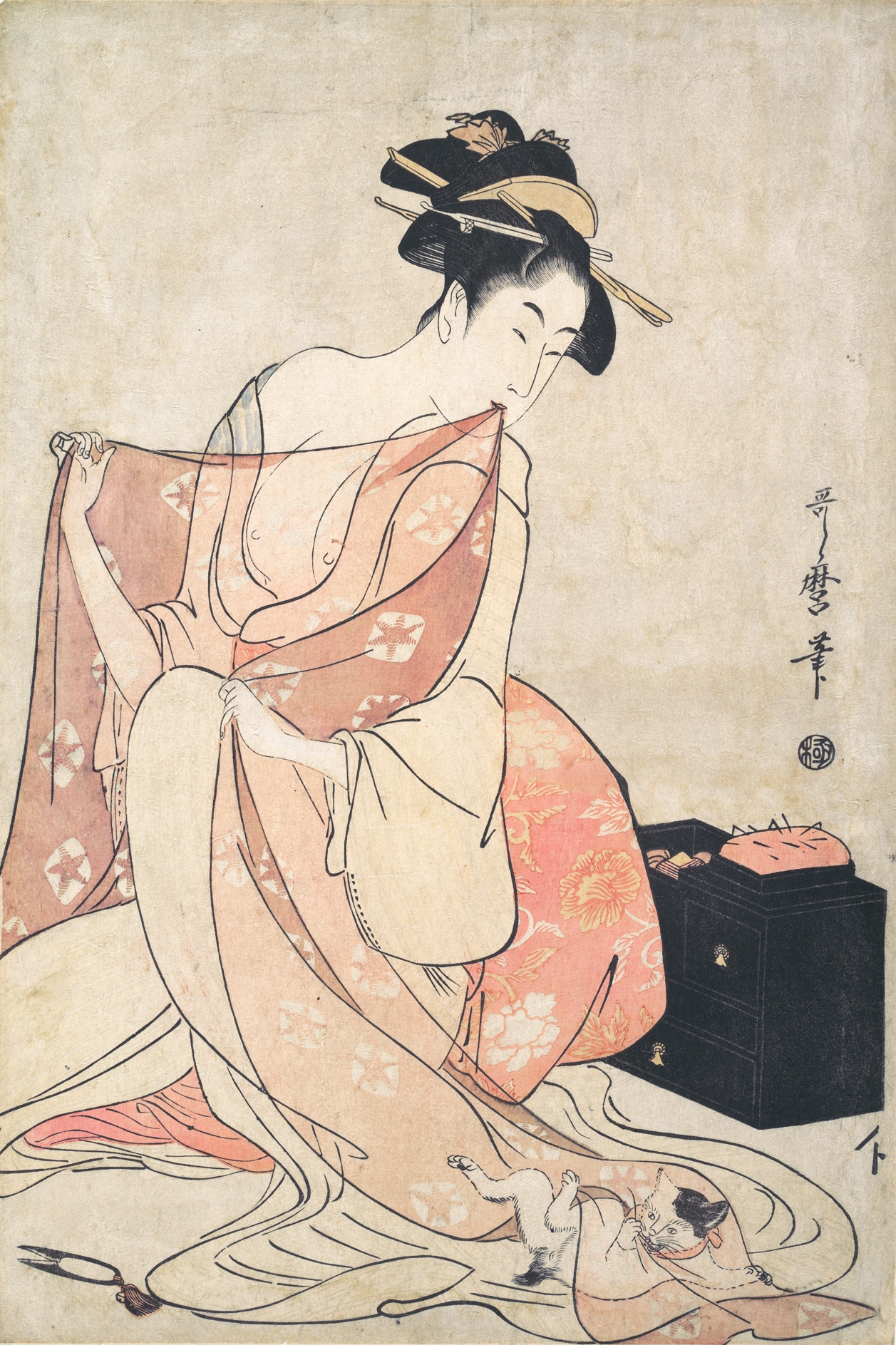
Utamaro’s women were charming, full of life, and the designs often had an element of humour.
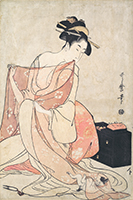
Woman and Cat (with mica ground)
By Utamaro (1754-1806), c.1793-94
The MET, New York
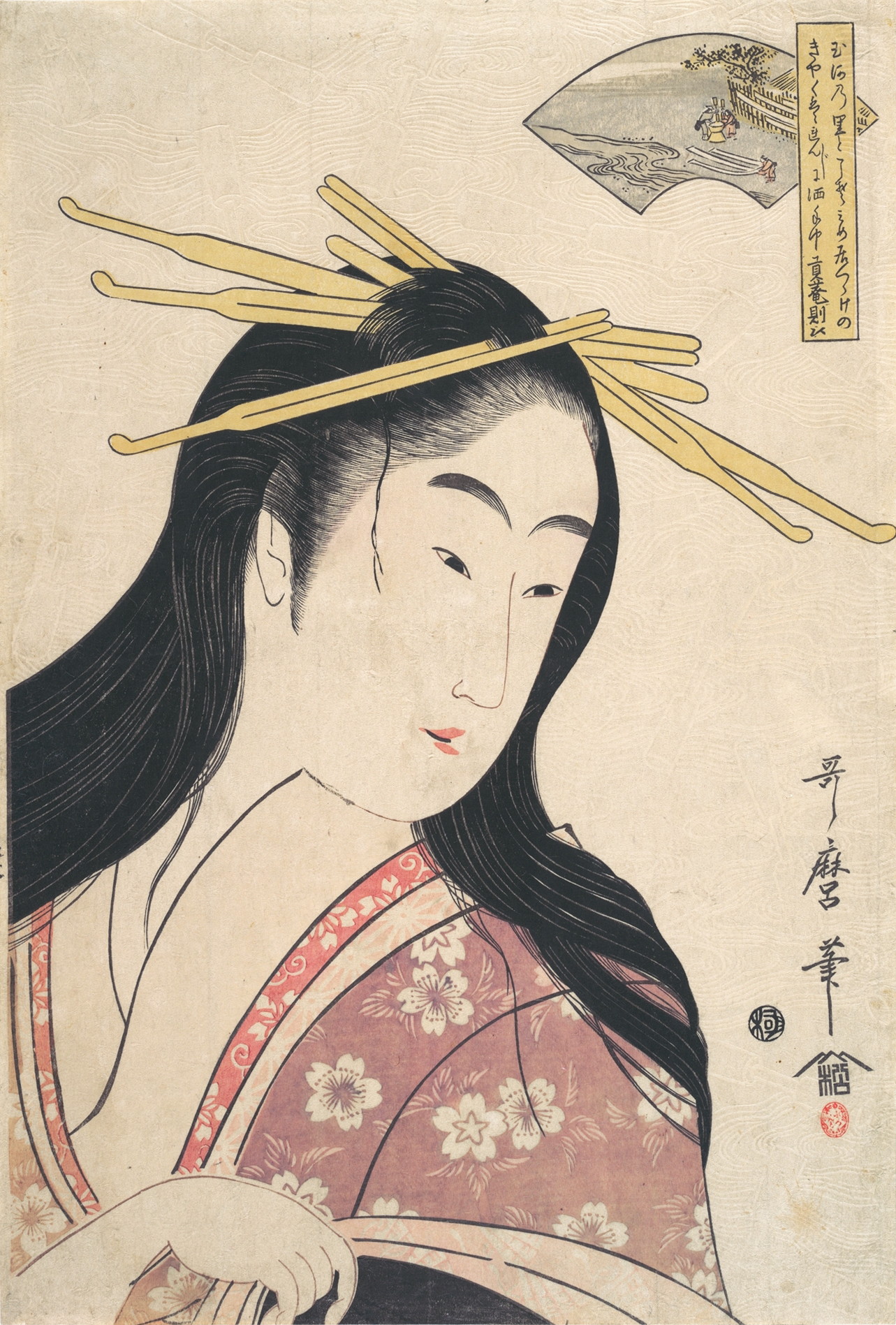
His most famous designs are his “close-ups”, or bust portraits of beautiful women.
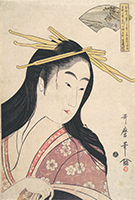
Tetsukuri no Tamagawa, from series “Six Tama Rivers”
(with embossed ground)
By Utamaro (1754-1806), c.1798
The MET, New York
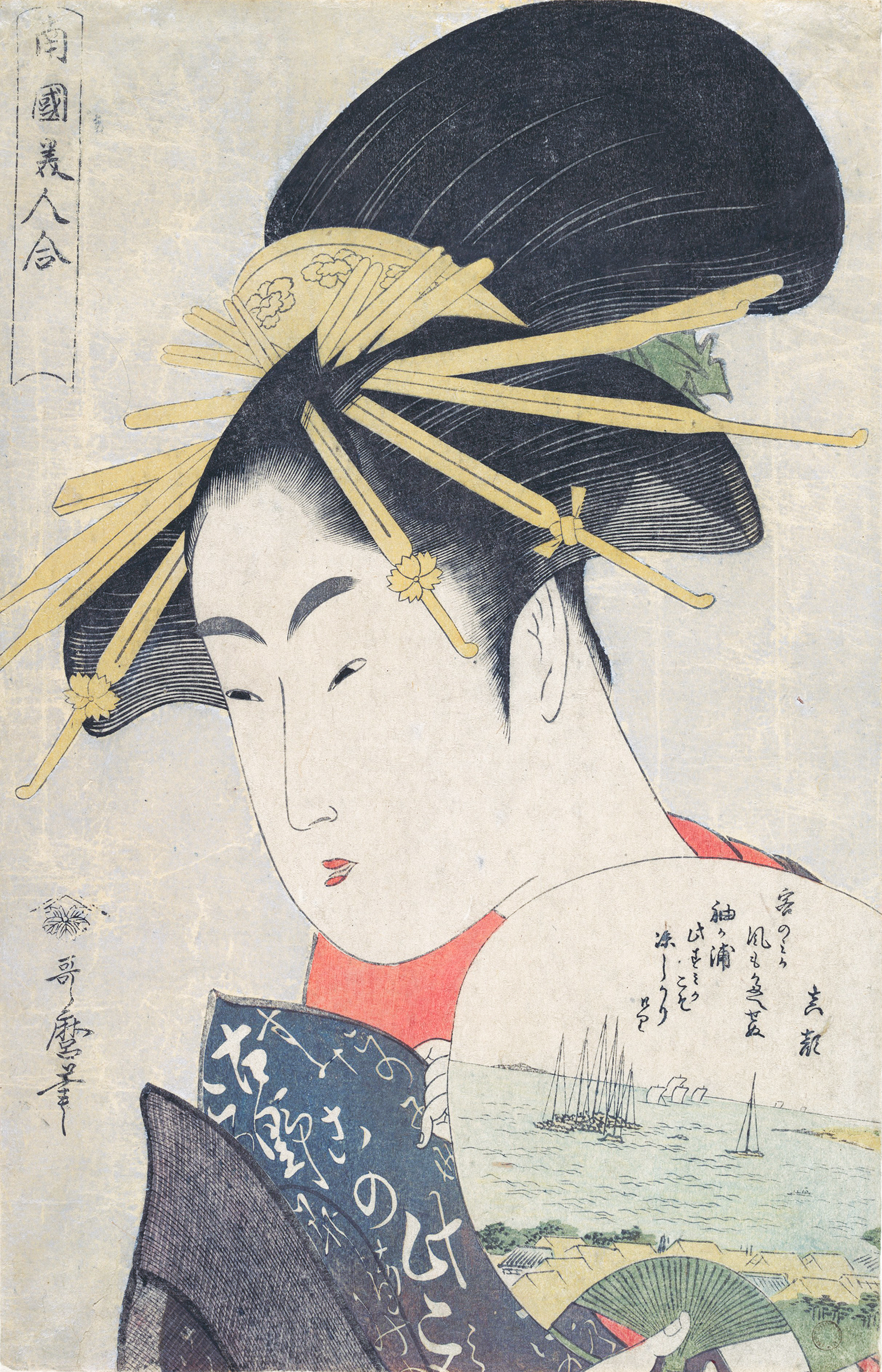
A 1791 edict prohibited lavish books. Some publishers responded by making oban prints more lavish instead, adding deluxe effects like embossing or powdered mica. The results are prints that are still considered to be the most beautiful ever produced.
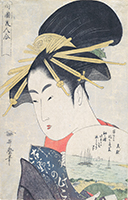
Konosumi, from series “Beauties of the Southern Quarter”
(with mica ground)
By Utamaro (1754-1806), c.1793-94
The MET, New York
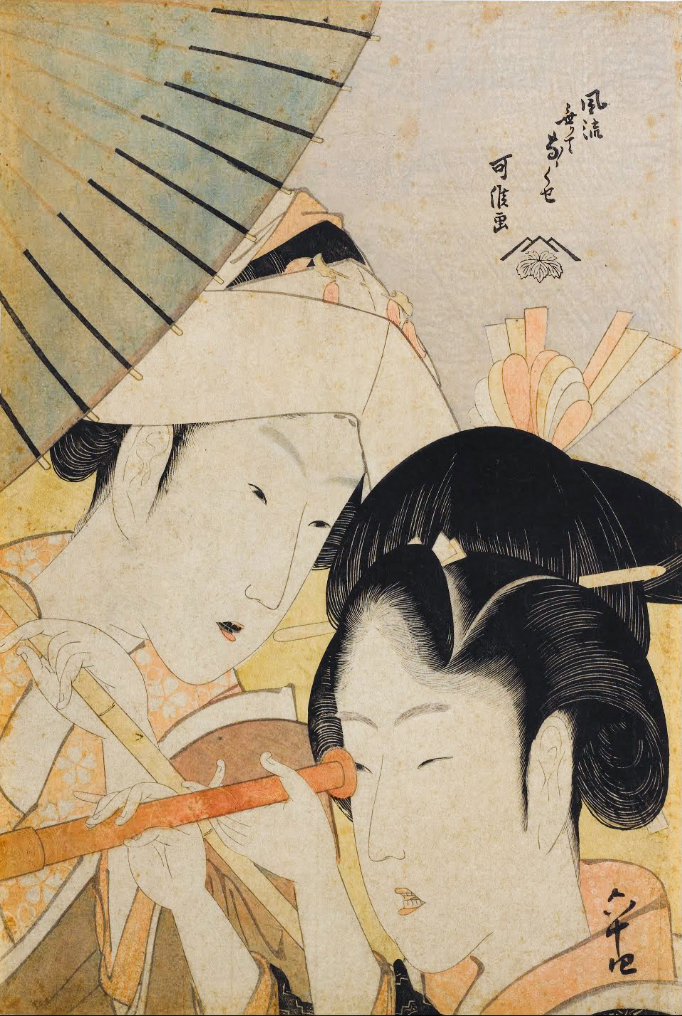
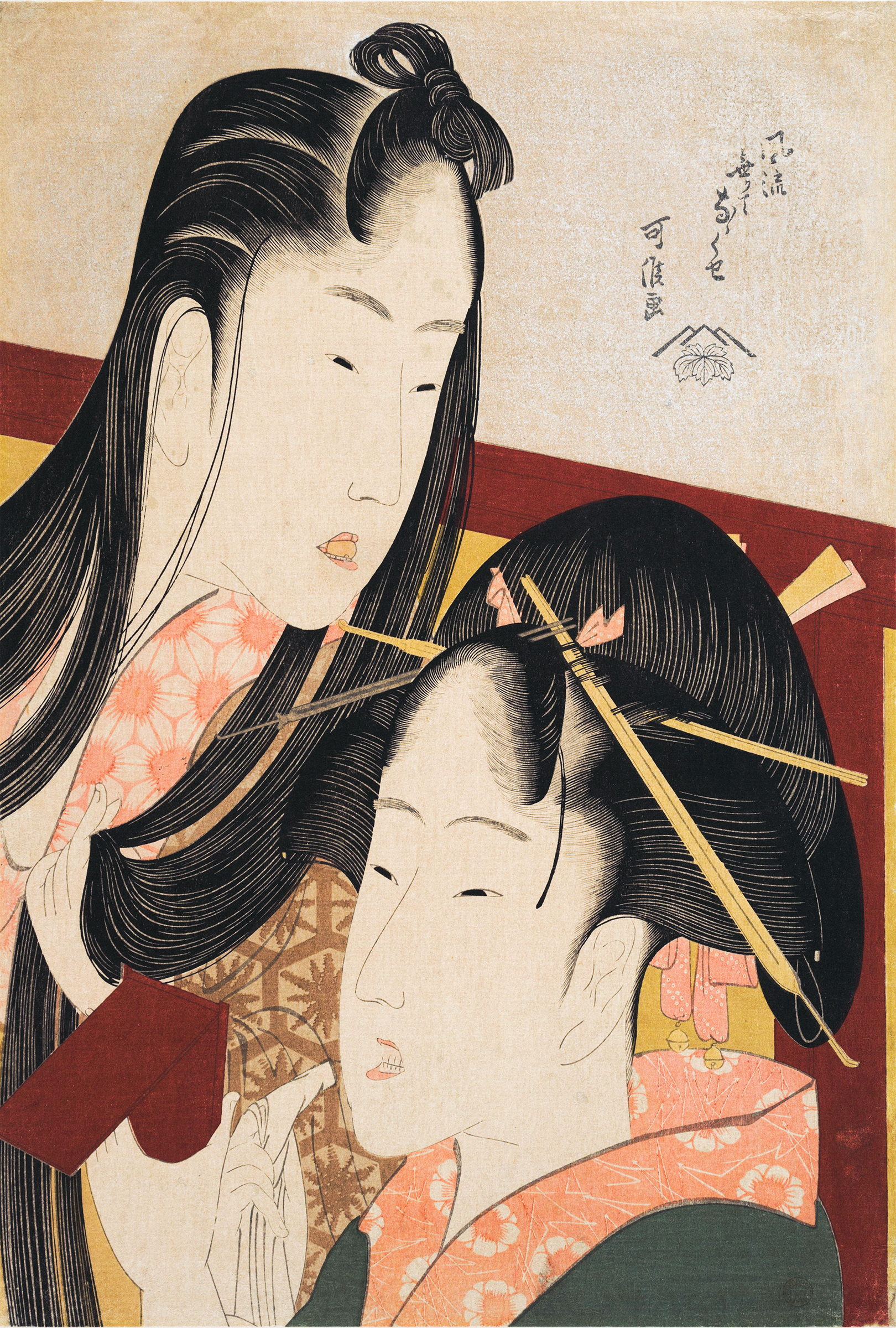
Hokusai tried his hand at this genre, but we only know of two oban beauty prints by him, though the series title suggests there were to be seven.
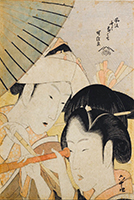
Two Ladies with a Telescope
Signed Kako ga (Hokusai), c. 1798
Kobe City Museum
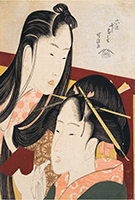
Squeaking a Ground Cherry
Signed Kako ga (Hokusai), c. 1798
The MET, New York
Various English translations of the title of this series are: Seven Stylish Foibles, Seven Fashionable Useless Habits, and Seven Habits of Grace and Disgrace.
The use of mica in prints was banned in the late 1790s and bust portraits of women were banned in 1800. They were considered too deluxe and extravagant for the chonin class.
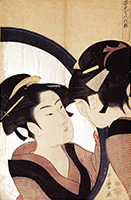
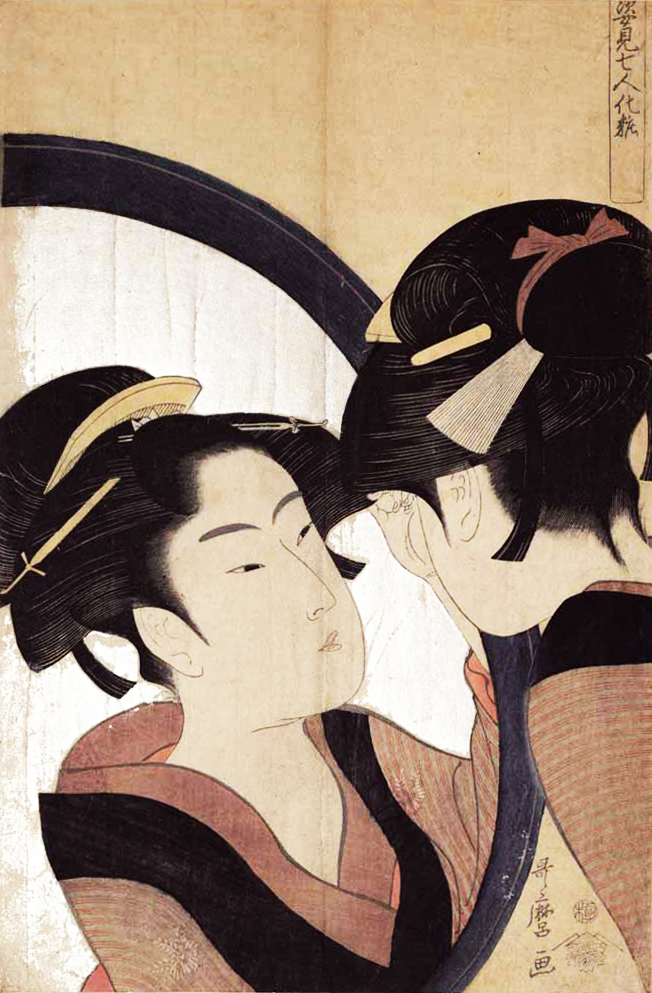
Naniwa Okita Admiring Herself in a Mirror
By Utamaro (1754-1806), c.1792-93
Tokyo National Museum
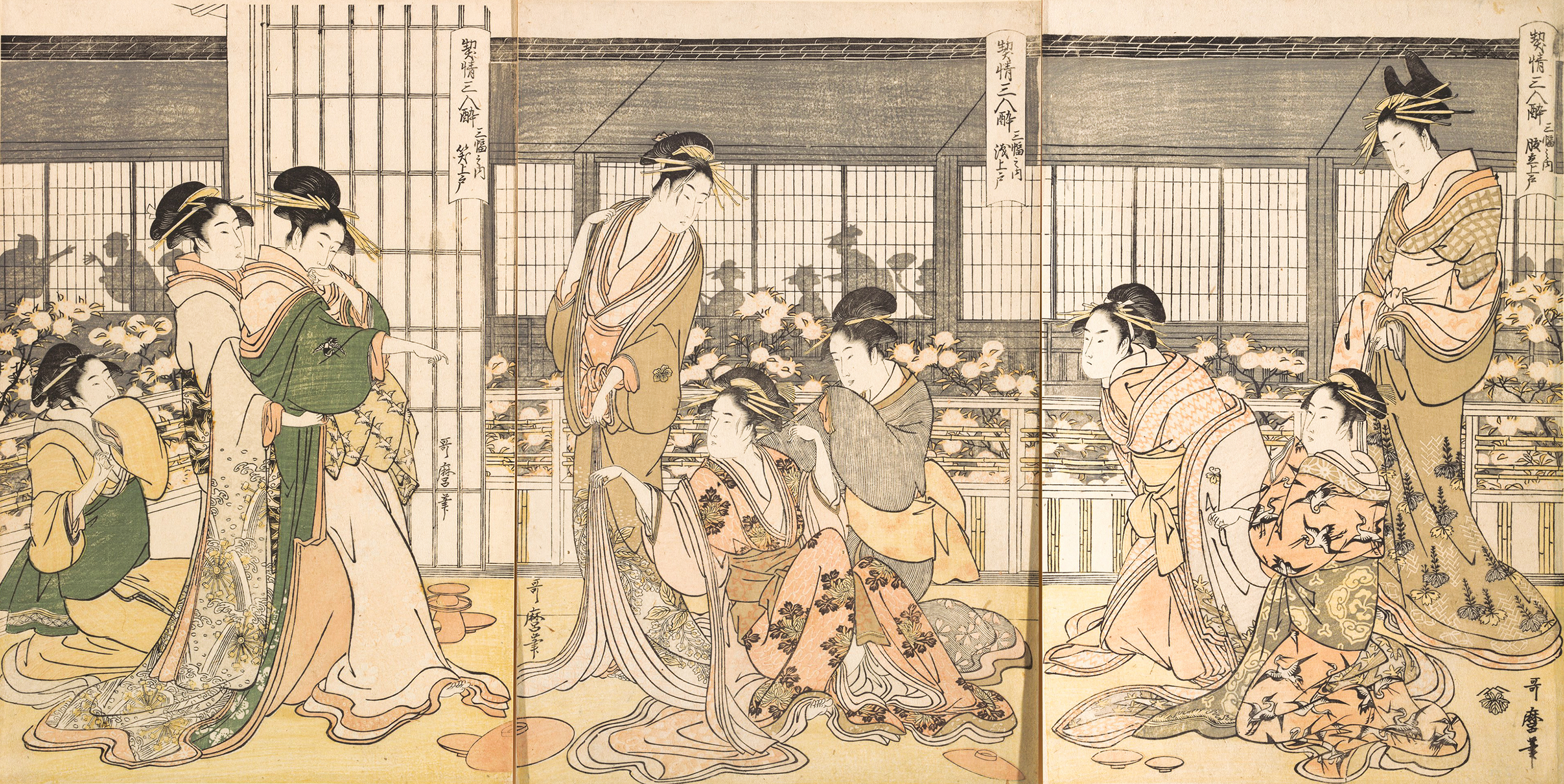
Utamaro and other artists of the period also designed mulit-sheet designs, mostly triptychs.
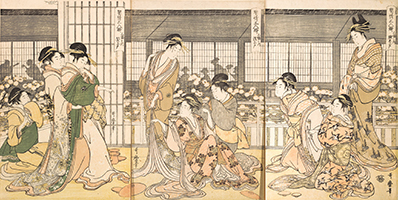
Intoxicated Courtesans
By Utamaro (1754-1806), c.1790s
The MET, New York
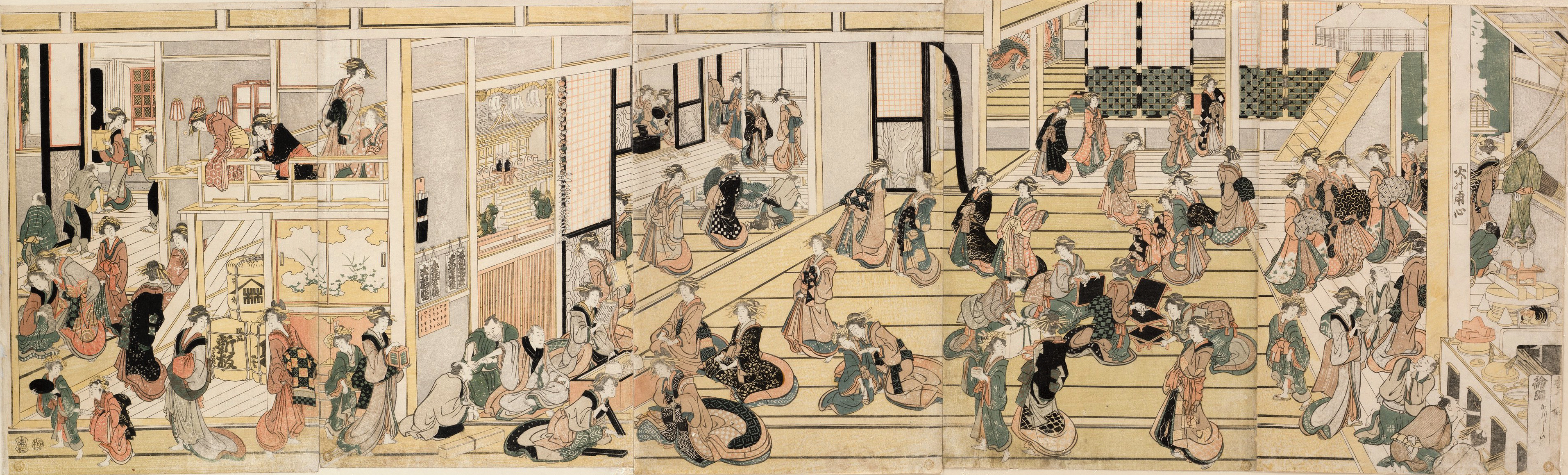
One such design by Hokusai exists, a pentaptych.
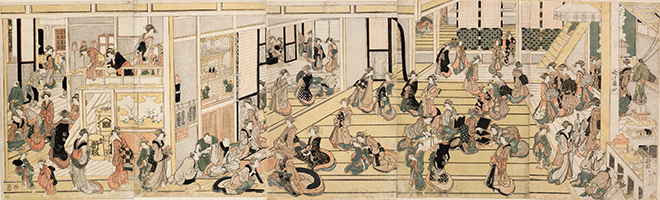
New Year's Day at the Ōgiya Brothel, Yoshiwara
By Katsushika Hokusai, c.1804
The MET, New York
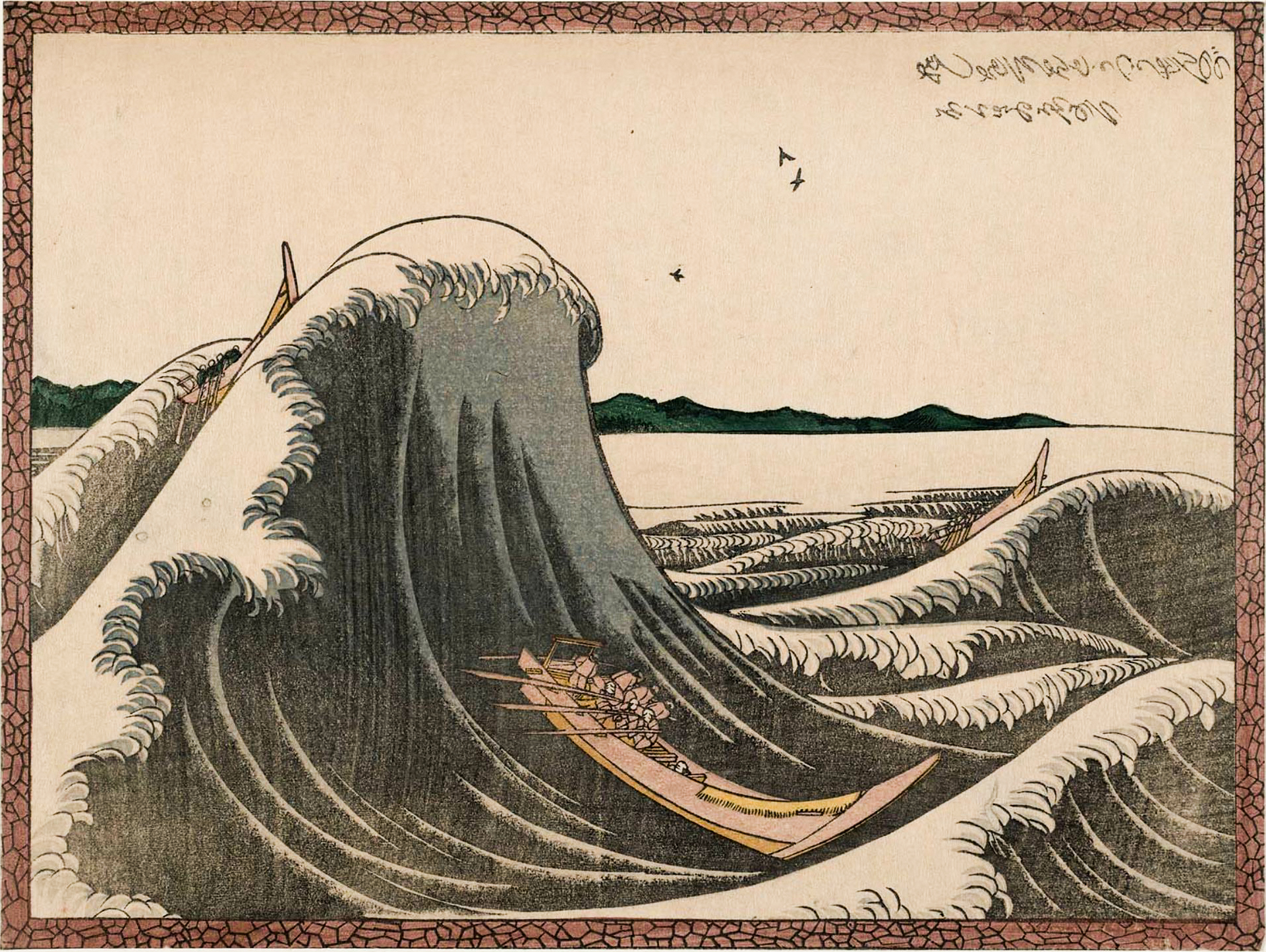
As mentioned before, during the first decades of Hokusai’s time as an independence artist he excelled more in the areas of book illustration and surimono design (privately commissioned prints) than in commercial ukiyo-e. His best commercial work from the period was in smaller formats, including a koban (one quarter the size of an oban) series of Western-style landscapes. Hokusai’s signature and the title are written in cursive style horizontally to mimic western writing. The designs even appear in a “frame”.
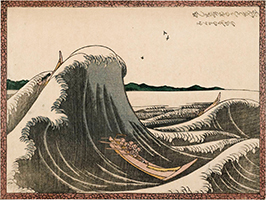
Fast Skiffs Navigating Large Waves
From an untitled series of Western-style landscapes
(signature and title written in cursive, horizontal style)
Koban, by Hokusai, c.1804-06
The Museum of Fine Arts, Boston
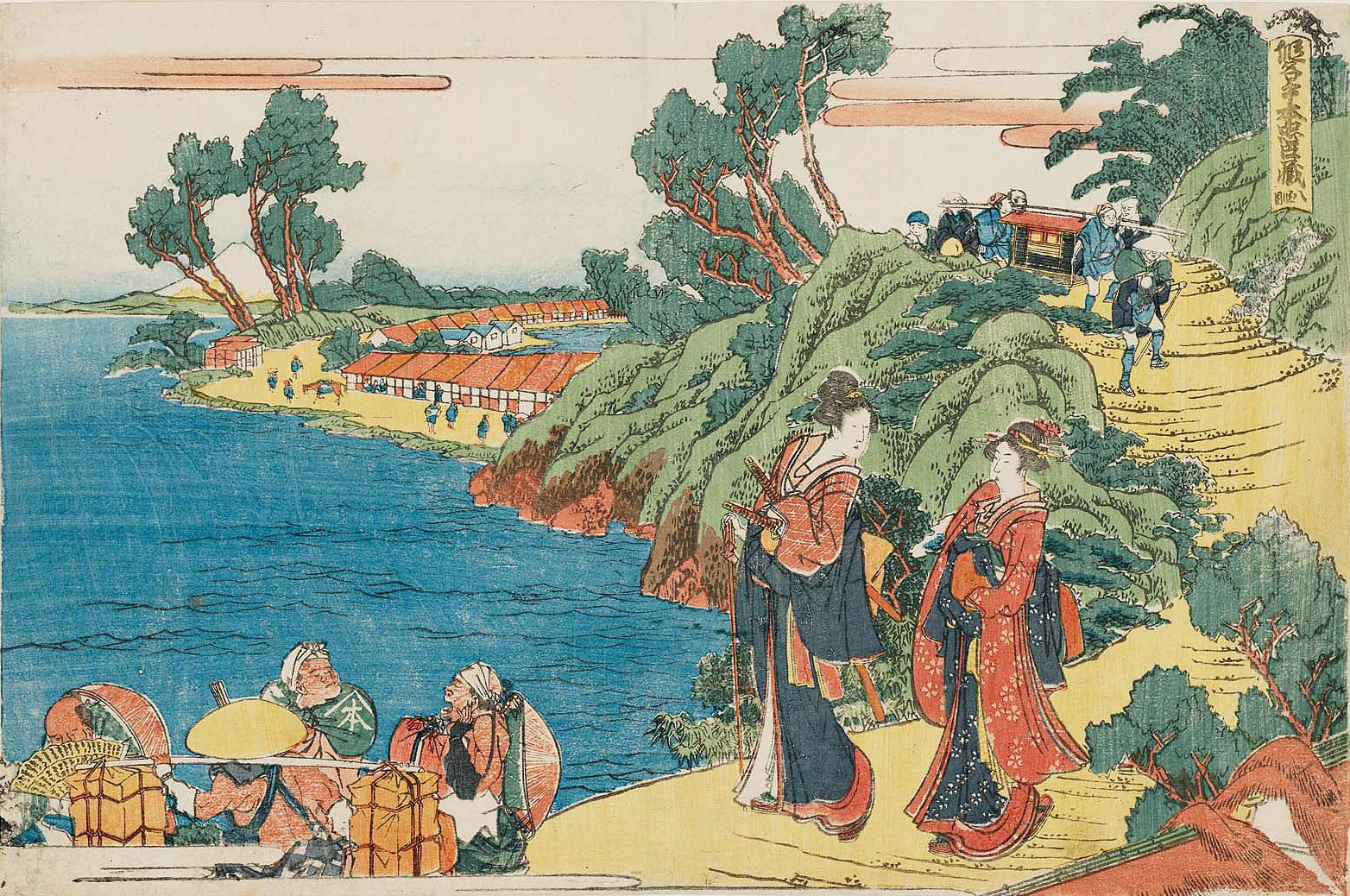
At the beginning of the 19th century Hokusai designed some series based on the play Chushingura, which was based on the Ako incident, also known as the 47 ronin incident, a real event that took place at the beginning of the 18th century. Hokusai claimed that his mother’s grandfather was a samurai involved in this event. In 1801 he designed a vertical chuban size (half the oban size) series and in 1806 a horizontal oban size set. Both sets incorporated Mount Fuji into two designs and some of the oban set were essentially landscape designs.
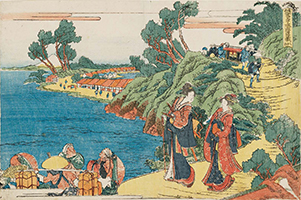
Act 8 from the series: The Storehouse of Loyal Retainers, a Primer
By Hokusai, 1806
The Museum of Fine Arts, Boston
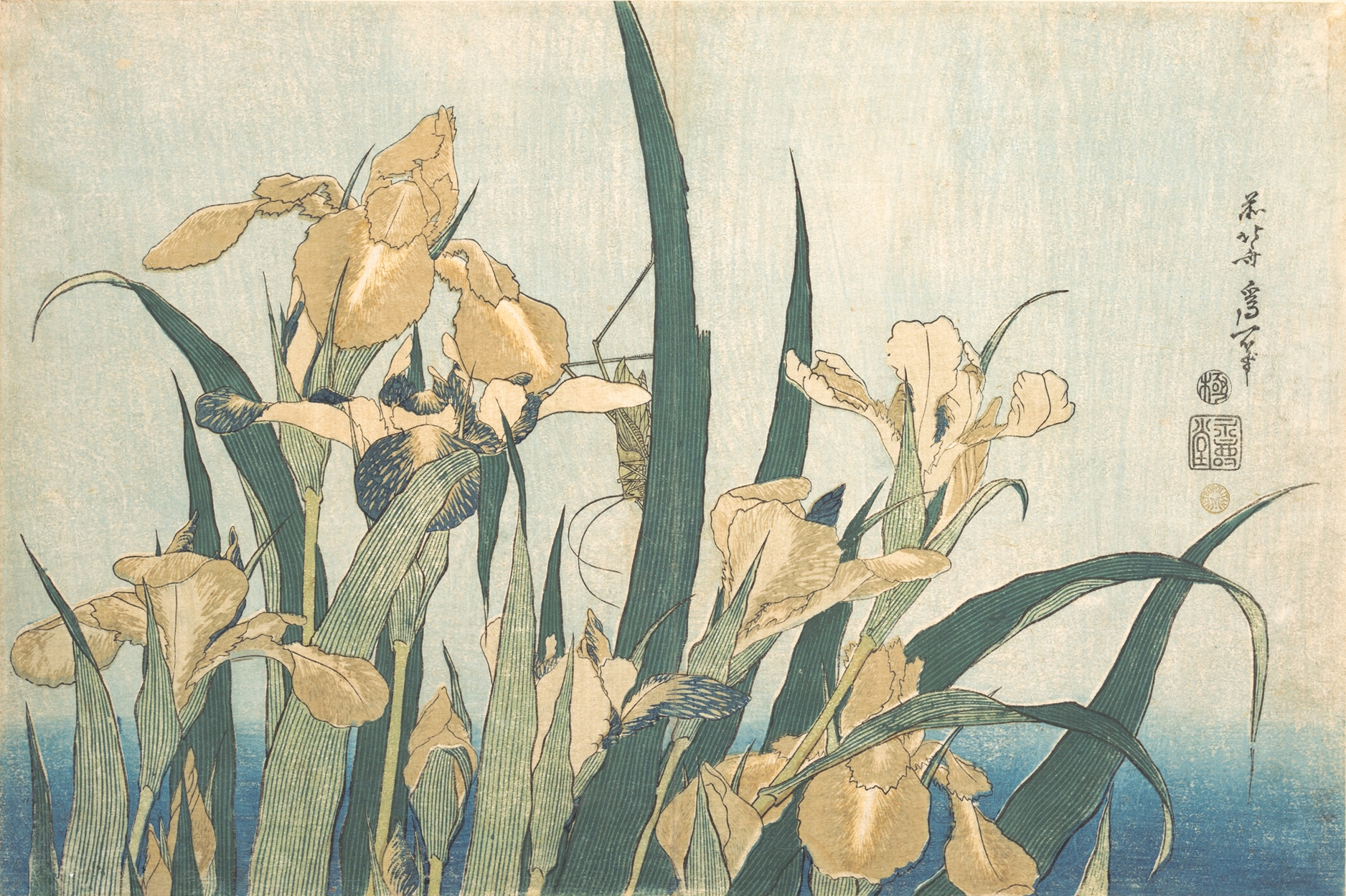
Hokusai also designed nature prints featuring birds and flowers.
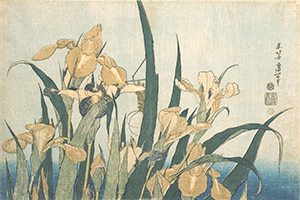
Grasshopper and Iris, c.1820s, oban size (faded)
Signed Zen Hokusai Iitsu
The MET, New York
None of Hokusai’s large print designs produced prior to 1830 are especially noteworthy, however this was not where he was focusing his efforts. His best prints were the surimono (privately commissioned prints) and he was primarily a book illustrator and a painter, and of course he was also a sort of performance artist.
In the Edo Period people travelled around the country more than ever before, initially on government business and for trade. This resulted in a network of roads along which were towns providing food and accommodation, and this in turn encouraged travel for personal reasons. Travel guide books, road maps, and city guides had been produced since the 1600s, yet landscapes were not a common subject of woodblock prints. One factor that inhibited the development of the landscape genre within ukiyo-e was the lack of a stable blue pigment.
In the late 1820s a deep blue pigment known as Prussian blue became available for use in prints.
This blue pigment was created by a paint maker in Berlin around 1706. It is the first modern synthetic pigment and is produced by oxidation of ferrous ferrocyanide salts. When mixed with hydrogen peroxide or sodium chlorate it becomes Prussian Blue. In 1752 a French chemist discovered how to reduce it to a powder which could be reconstituted with hydrogen cyanide.
Prussian blue was used for art in Europe as early as 1709. Also, it was used to dye the uniforms of the Prussian army from the early 1700s through to the early 1900s, hence the name Prussian blue, although in Prussia they called it Berlin blue. It is still in wide use – perhaps in the ink in your pen – and is not only a pigment, but is used medicinally as an antidote for certain kinds of heavy metal poisoning.
Prussian blue reached Japan via China in the later 1700s, but was very expensive. By the late 1820s it became available in sufficient quantity and at a low enough price that it could be used for woodblock prints. It was called berorin in Japanese.
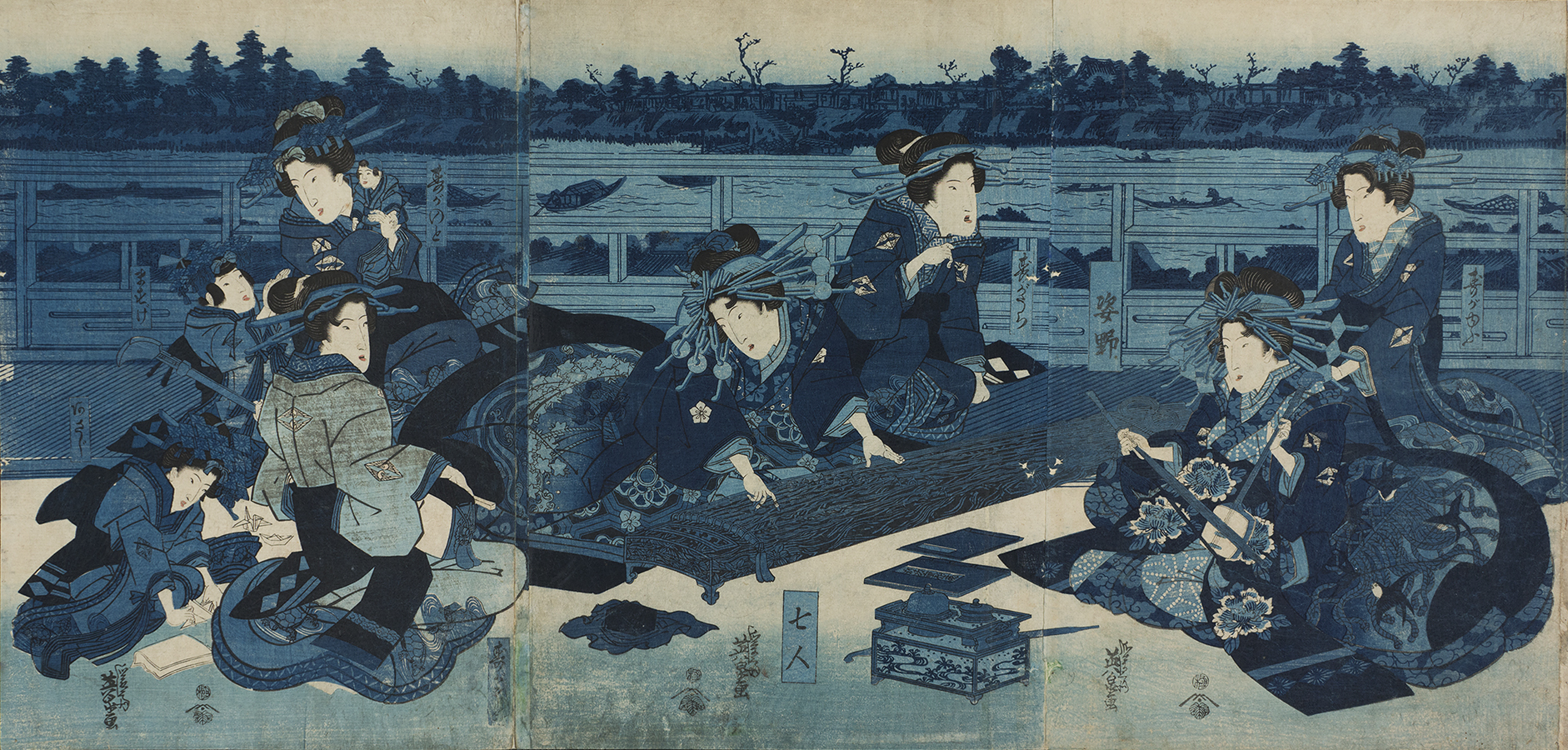
The artist Eisen (1790-1848) is credited with the first use of Prussian blue in a woodblock print (a fan print). Prussian blue could be applied in a range of shades from light to deep blue and had a luster the traditional indigo blue lacked. Very quickly artists began producing designs all, or mostly in shades of Prussian blue. These were called aizuri prints, or aizuri-e.
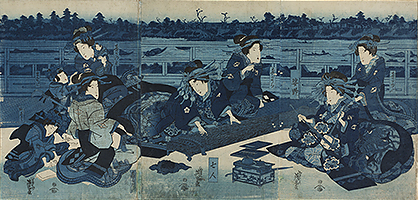
The Grand Courtesans Sugatano and Nanabito with Attendants
By Eisen, c.1830
At the end of 1830 Hokusai’s publisher announced the publication of a series called Thirty Six Views of Mount Fuji by Hokusai. This would prove to be an extremely popular series and Hokusai’s most famous. There may have been more than 5-8000 impressions made of the more popular designs, a very impressive number considering it was extremely rare at the time for a print design to come close to 1000 impressions.
Why was Mount Fuji chosen as the subject of Hokusai’s first major landscape series? Fuji is Japan’s largest mountain, 3,776 meters in height, and it is an active volcano. It has erupted numerous times throughout Japan’s history. The last eruption was in 1707, an event that Hokusai may have had described to him by older people when he was a child (he was born in 1760). In Japanese mythology Mount Fuji was associated with immortality and it is possible that Hokusai gravitated to it as a subject because of his own desire for longevity. One very likely reason to choose the volcano as a subject was that there was a sect in Edo that worshipped Fuji. As early as 1779 model Fuji’s were being constructed in Edo so that those who were not able to climb the real mountain could climb the model, and thereby receive the same spiritual merit as would be gained by scaling the real mountain (women were forbidden to climb Fuji and it was too strenuous a climb for some men).
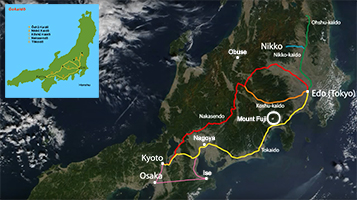
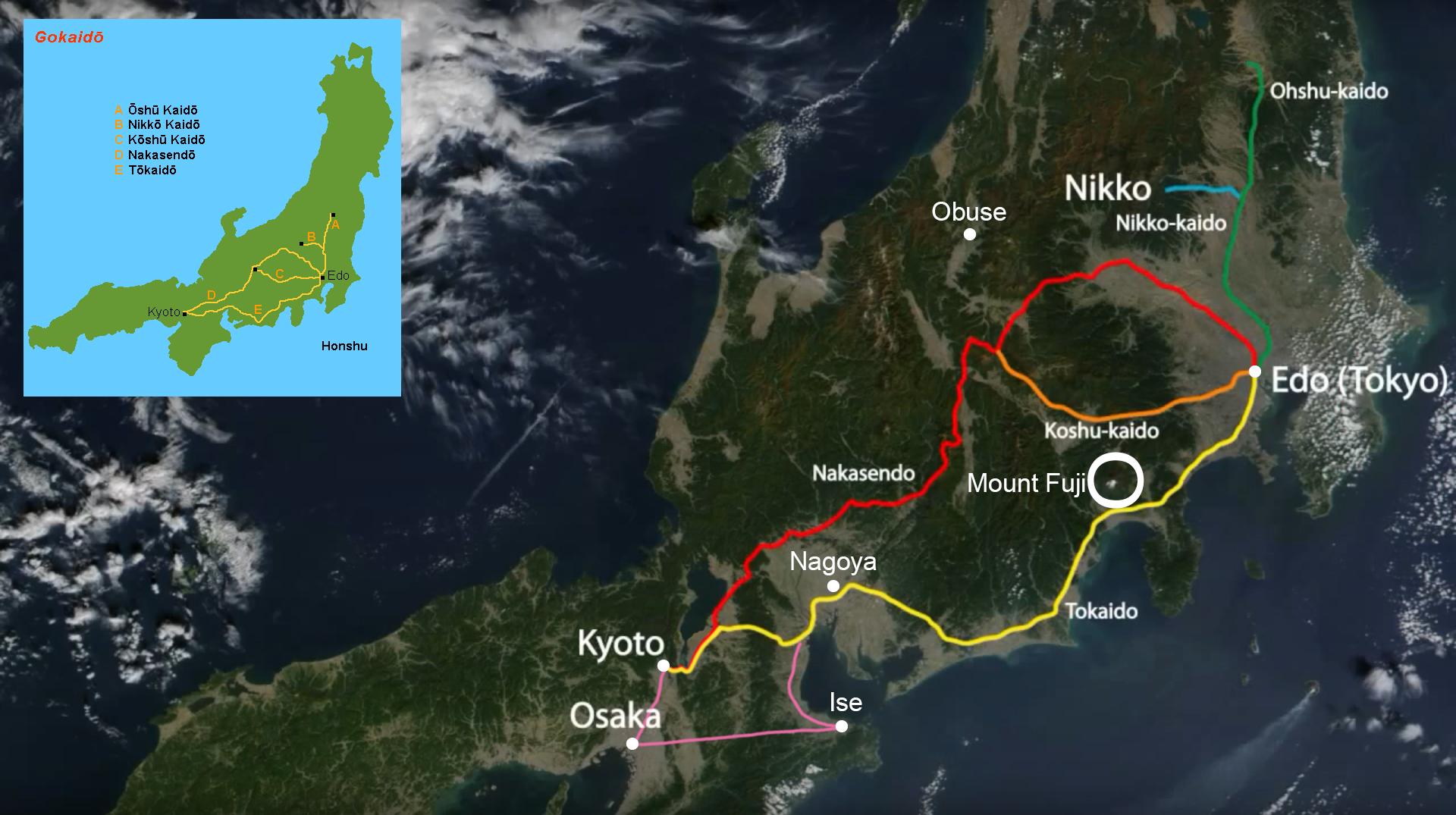
Map showing the location of Mount Fuji and Nagoya where the first volume of Hokusai’s Manga was published in 1814 and where he painted a giant Daruma in 1817.
On a clear day Fuji could easily be seen from Edo.
Also indicated is Obuse, which will be discussed later.
The Thirty Six Views of Mount Fuji was originally advertised as an aizuri series and the first five published were completely in shades of blue. The second group of five prints included one colour in addition to shades of blue and the third group of five had muted colours. It is thought that the first group represented the dim light of pre-dawn, the second the beginning sunrise, and the third when the sun is still low and it is not yet full daylight. These first 15 prints were reissued later in full colour. The rest of the 36 prints were originally in bright colours, though they retained a blue outline instead of the traditional black outline found in other full-colour prints.
As the series had proved so popular an additional ten designs were produced in full colour with the traditional black outline.
Following are all 46 designs from TheThirty Six Views of Fuji Series. These are all from the collection of The MET, New York. I have selected the earliest impression of each design that I found within the MET’s collection. Please keep in mind that these are not necessarily the earliest impressions that were made.
The Thirty Six Views of Fuji Series:
- Shichirigahama Beach, Sagami Province
- Tsukuda Island, Musashi Province
- Lake Suwa, Shinano Province
- Ushibori, Hitachi Province
- Kajikazawa, Kai Province
- Near Umezawa Manor, Sagami Province
- Mishima Pass, Kai Province
- Ejiri, Suruga Province
- Under the Wave off Kanagawa (The Great Wave)
- Honganji Temple at Asakusa, Edo
- The Tama River, Musashi Province, Edo
- Clear Day with a Southern Breeze (Mount Fuji at Dawn or Red Fuji)
- Fujimigahara, Owari Province
- Sudden Rain Beneath the Summit (or Thundestorm Beneath the Summit)
- In the Totomi Mountains
- Sazai Hall, Five Hundred Rakan Temple
- Snowy Morning, Koishikawa
- Onden Waterwheel
- Sumida River, Sekiya Village
- Under the Mannen Bridge at Fukagawa, Edo
- Surugadai, Edo
- The Cushion-pine at Aoyama, Edo
- Senju, Musashi Province
- Inume Pass, Kai Province
- The Mitsui Stores at Surugacho, Edo
- Viewing Sunset over the Ryogoku Bridge from the Ommaya Embankment
- Lower Meguro
- Tago Bay near Ejiri on the Tokaido Road, Abridged View
- Yoshida on the Tokaido Road
- At Sea Off Kazusa
- The Nihonbashi Bridge, Edo
- The Bay of Noboto, Shimosa Province
- Hakone Lake, Sagami Province
- Hodogaya on the Tokaido Road
- Enoshima, Sagami Province
- Reflection in Lake Misaka, Kai Province
- Lumberyards on the Takekawa River at Honjo
- Fuji Seen from the Senju Pleasure Quarter
- Fuji from Gotenyama at Shinagawa on the Tokaido Road
- Nakahara, Sagami Province
- Dawn at Isawa, Kai Province
- The Back of Mount Fuji from the Minobu River
- The New Fields of Ono, Suruga Province
- Fuji from the Tea Plantation of Katakura, Suruga Province
- Fuji from Kanaya on the Tokaido Road
- Groups of Mountain Climbers
Hokusai’s Fuji series was reprinted many times and aspects of the printing change from one edition to the next. As previously mentioned, those originally printed as aizuri prints were later printed in colour. The first prints to be made of any design were always the most desirable as the blocks were the sharpest and sometimes extra elements were added to the first run for the most discerning collectors. In the design commonly known as Red Fuji, for example, there was an extra block for the trees that was printed in a lighter shade than the other trees.
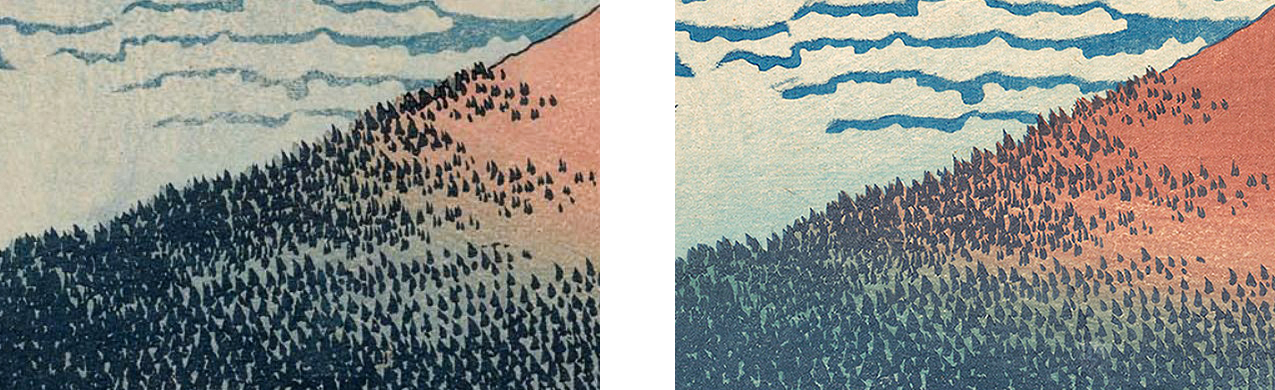
Detail from two early “Red Fuji” prints.
On the left is a very early one from the Museum of Fine Arts, Boston, with an extra grey block along the tree line, and on the right is an impression from the MET, New York
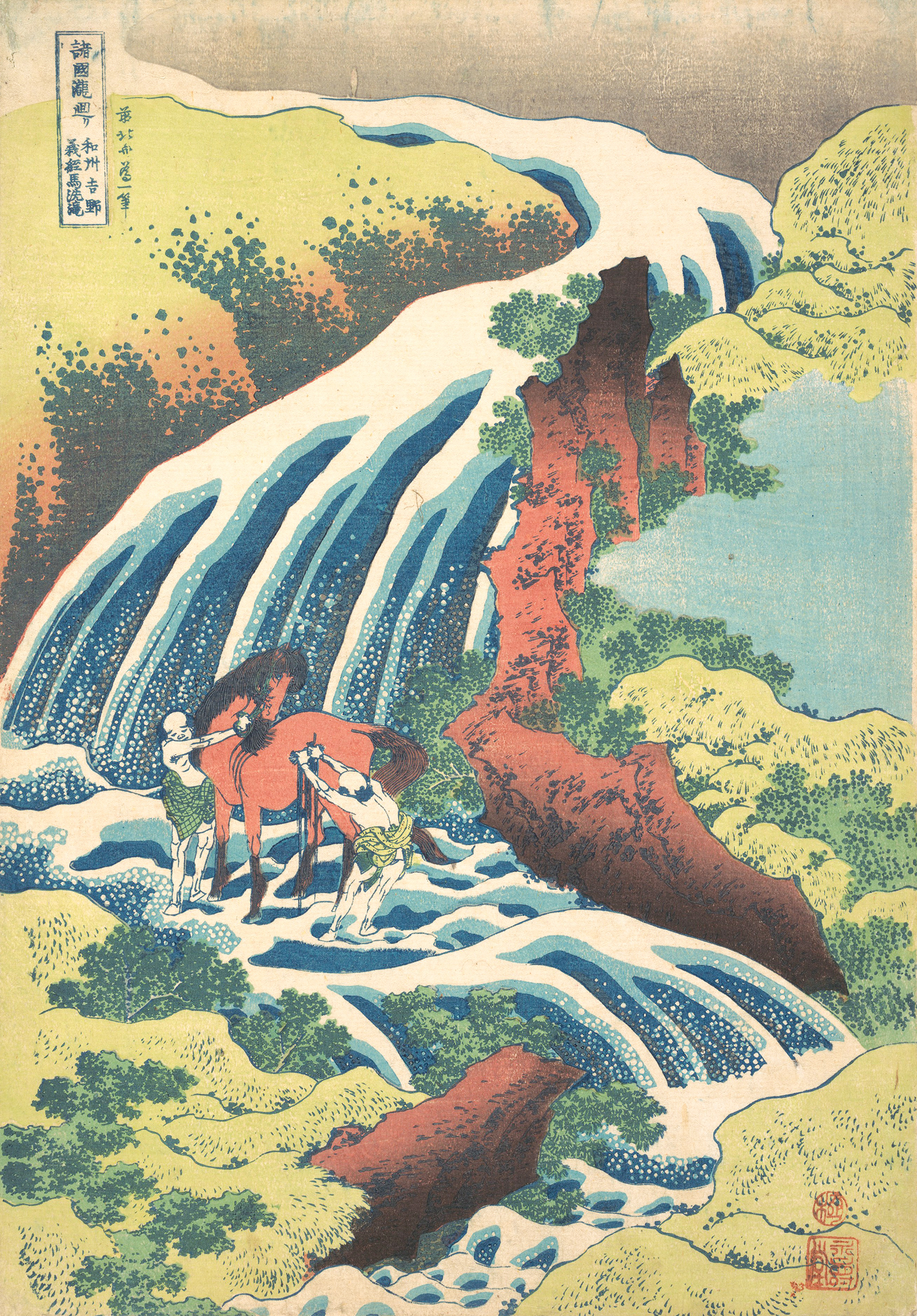
Following the successful Fuji series Hokusai designed the Tour of Waterfalls in Various Provinces series, c. 1833, containing eight designs.
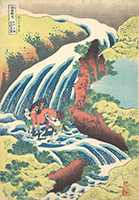
The Waterfall where Yoshitsune washed his horse in Yoshino, Yamato province
Tour of Waterfalls in Various Provinces, By Hokusai, c.1833
The MET, New York
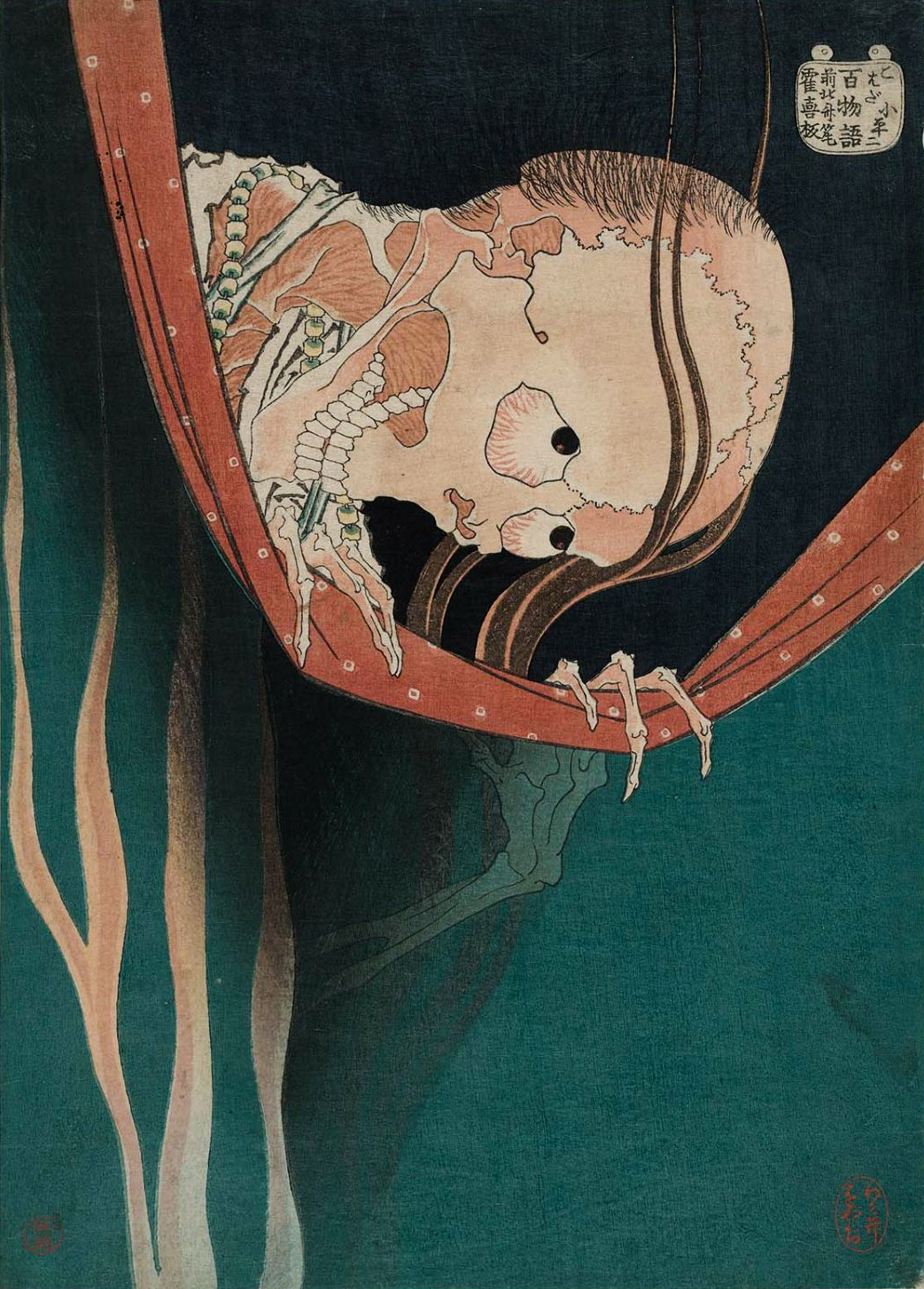
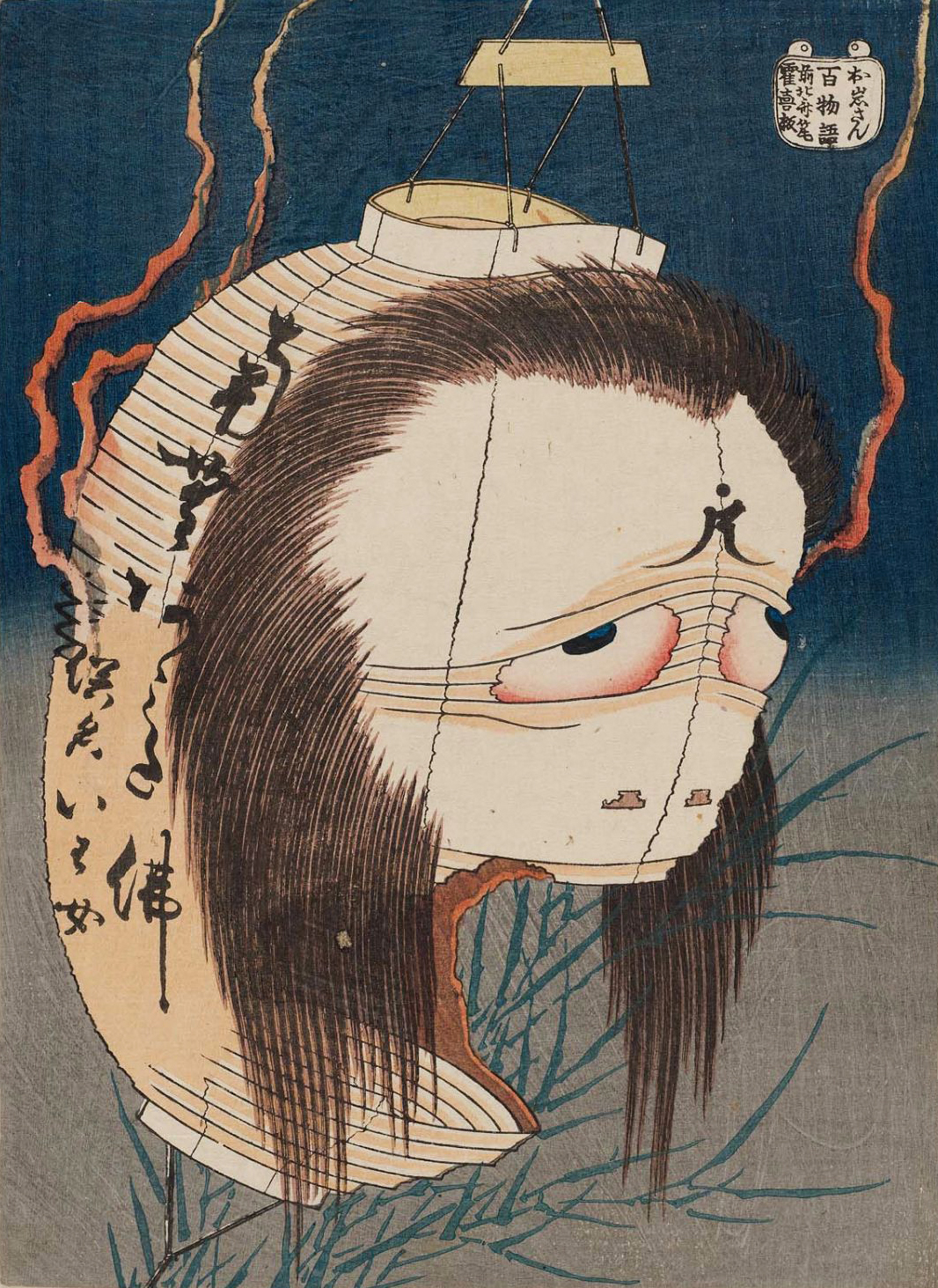
He began a chuban (half oban) sized ghost series called One Hundred Ghost Tales. Only five designs are known from this series.
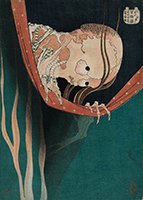
Kohada Koheiji (haunting his sleeping wife after she and her lover drowned him)
One Hundred Ghost Tales, Chuban series by Hokusai, c.1833
Museum of Fine Arts, Boston
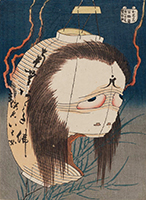
Oiwa-san (her face is merging with a festival lantern that is burning
One Hundred Ghost Tales, Chuban series by Hokusai, c.1833
Museum of Fine Arts, Boston
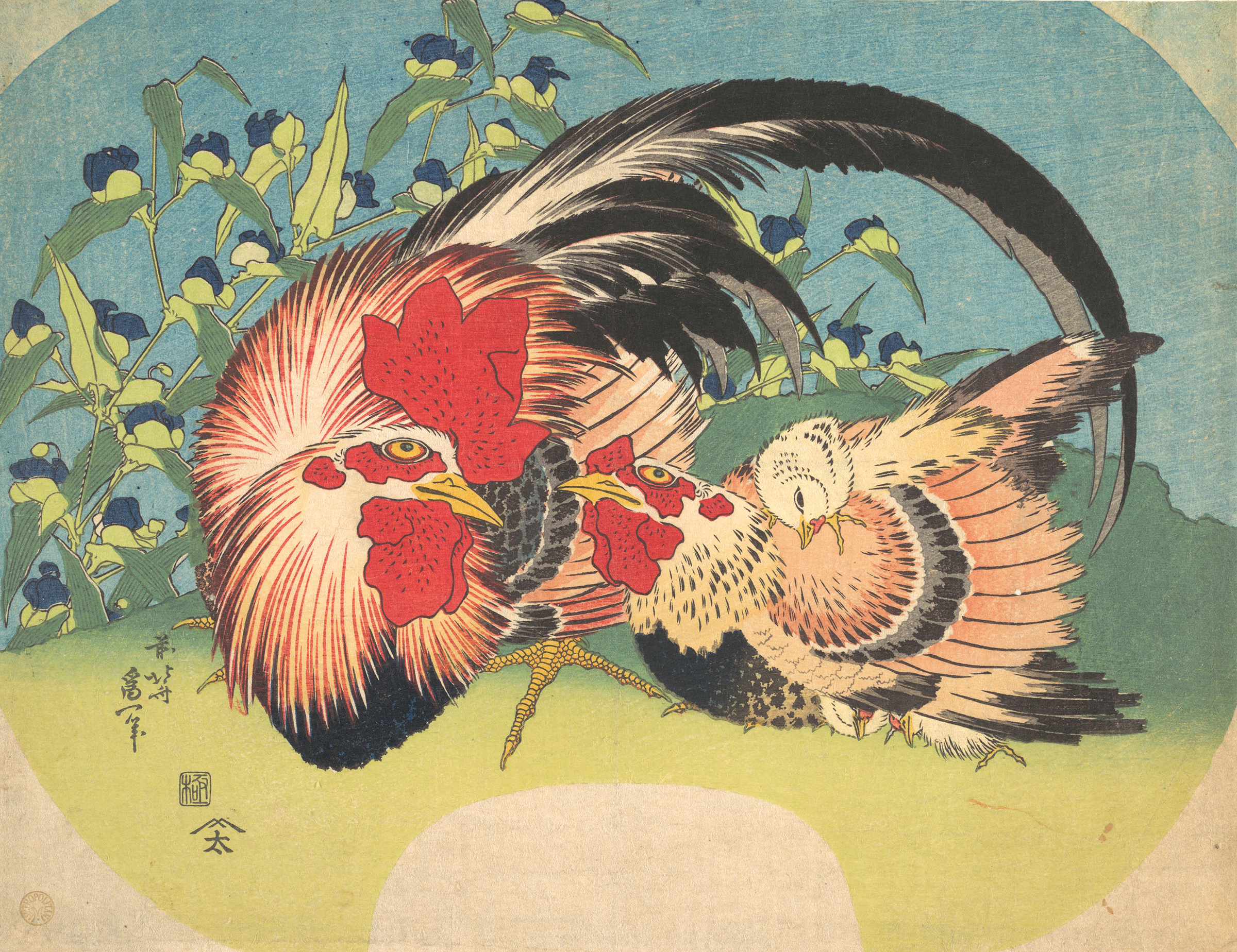
Hokusai also designed fan prints and a vertical chuban (half oban) series of birds and flowers.

Chickens with Spiderwort, c.1830-33, by Hokusai
The MET, New York
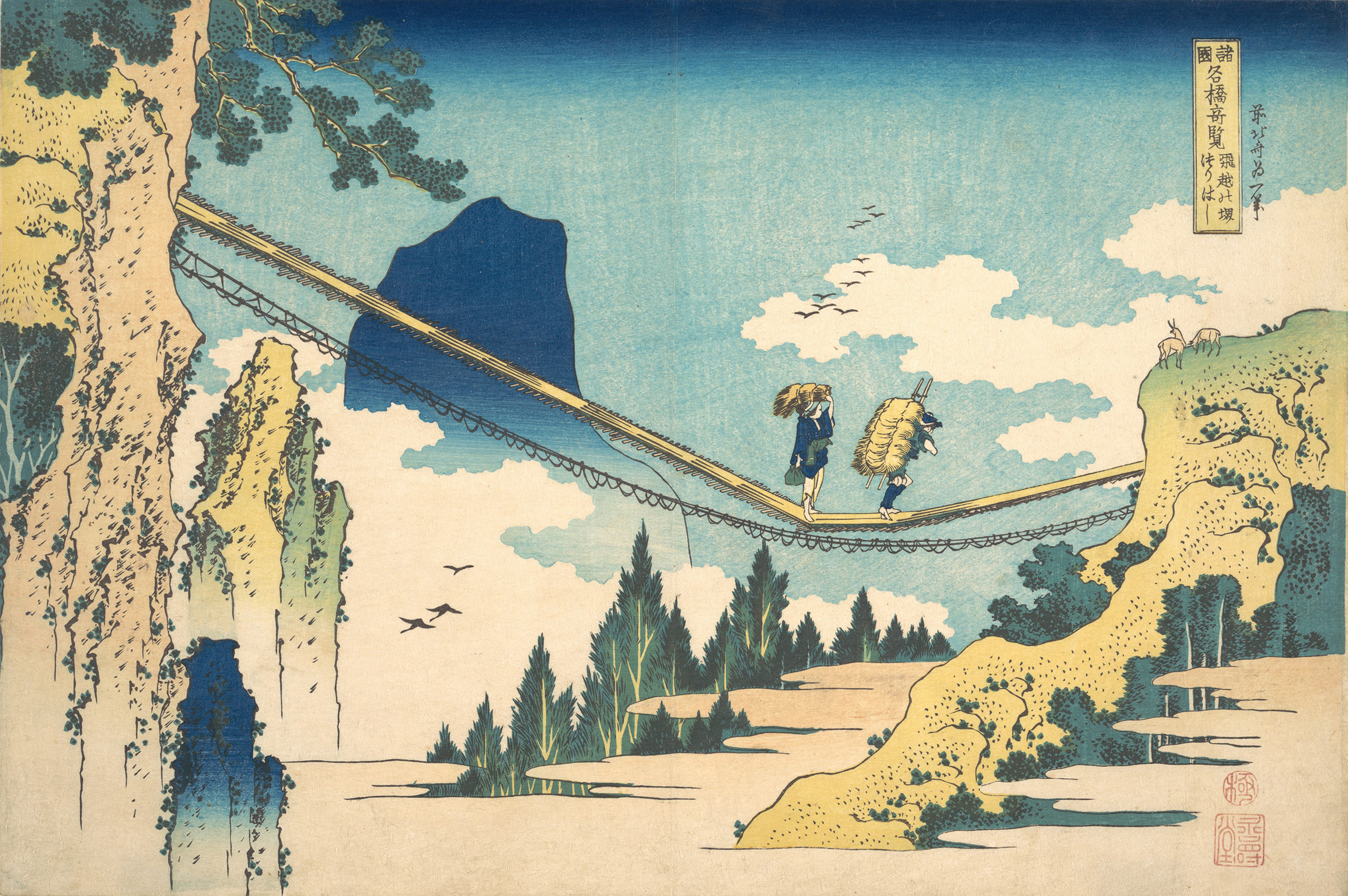
Around 1834 Hokusai began publishing Bridges in Various Provinces. Eleven designs are known from this series, which likely was to consist of at least twelve prints.
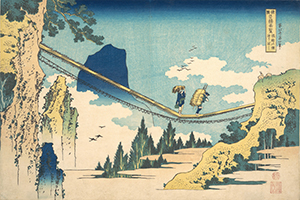
Suspension Bridge on the Border between Hizen and Etchu Provinces
Wondrous Views of Famous Bridges in Various Provinces
By Hokusai, c. 1834
The MET, New York
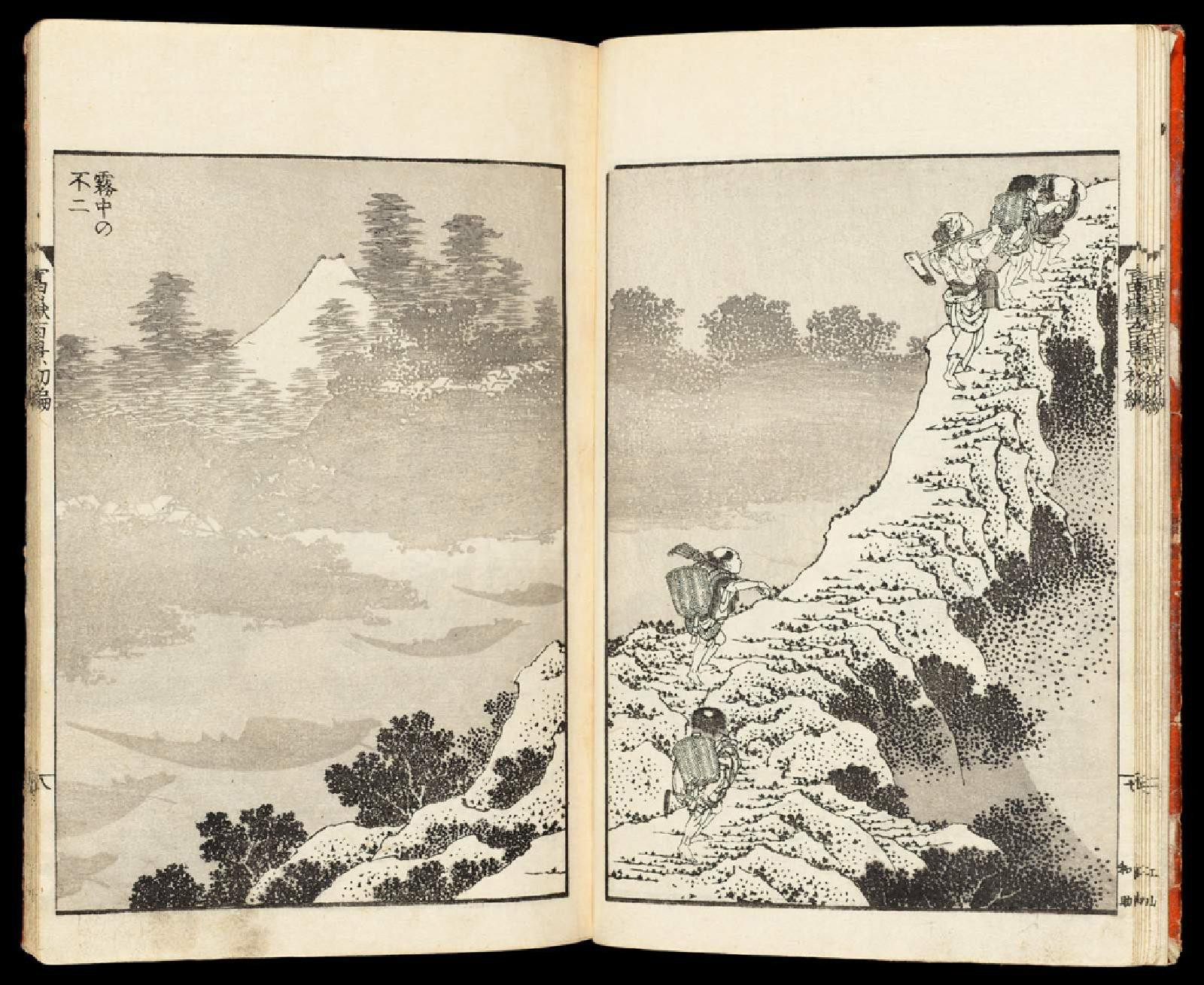
He also began to publish his set of One Hundred Views of Mount Fuji in 1834. These were monochrome designs, done in shades of black and grey, published in book form. Some designs covered two pages and some only a single page. The set was published in 3 volumes, with the first in 1834, the second in 1835 and the third not until 1847. The set includes a total of 102 images and is considered one of Hokusai’s greatest achievements.
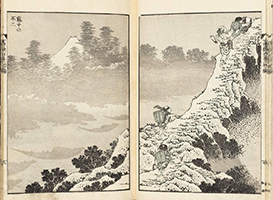
Fuji in the Mists, Volume 1
One Hundred Views of Mount Fuji
By Hokusai, 1834
The MET, New York
At the beginning of the first volume of One Hundred Views of Mount Fuji Hokusai famously wrote:
“From the age of six I had a penchant for copying the form of things, and from about fifty, my pictures were frequently published; but until the age of seventy, nothing that I drew was worthy of notice. At Seventy-three years, I was somewhat able to fathom the growth of plants and trees, and the structure of birds, animals, insects and fish. Thus when I reach eighty years, I hope to have made increasing progress, and at ninety to see further into the underlying principles of things, so that at one hundred years I will have achieved a divine state in my art, and at one hundred and ten, every dot and every stroke will be as though alive. Those of you who live long enough, bear witness that these words of mine prove not false.”
By this time Hokusai was signing himself: Manji, Old Man Mad about Painting.
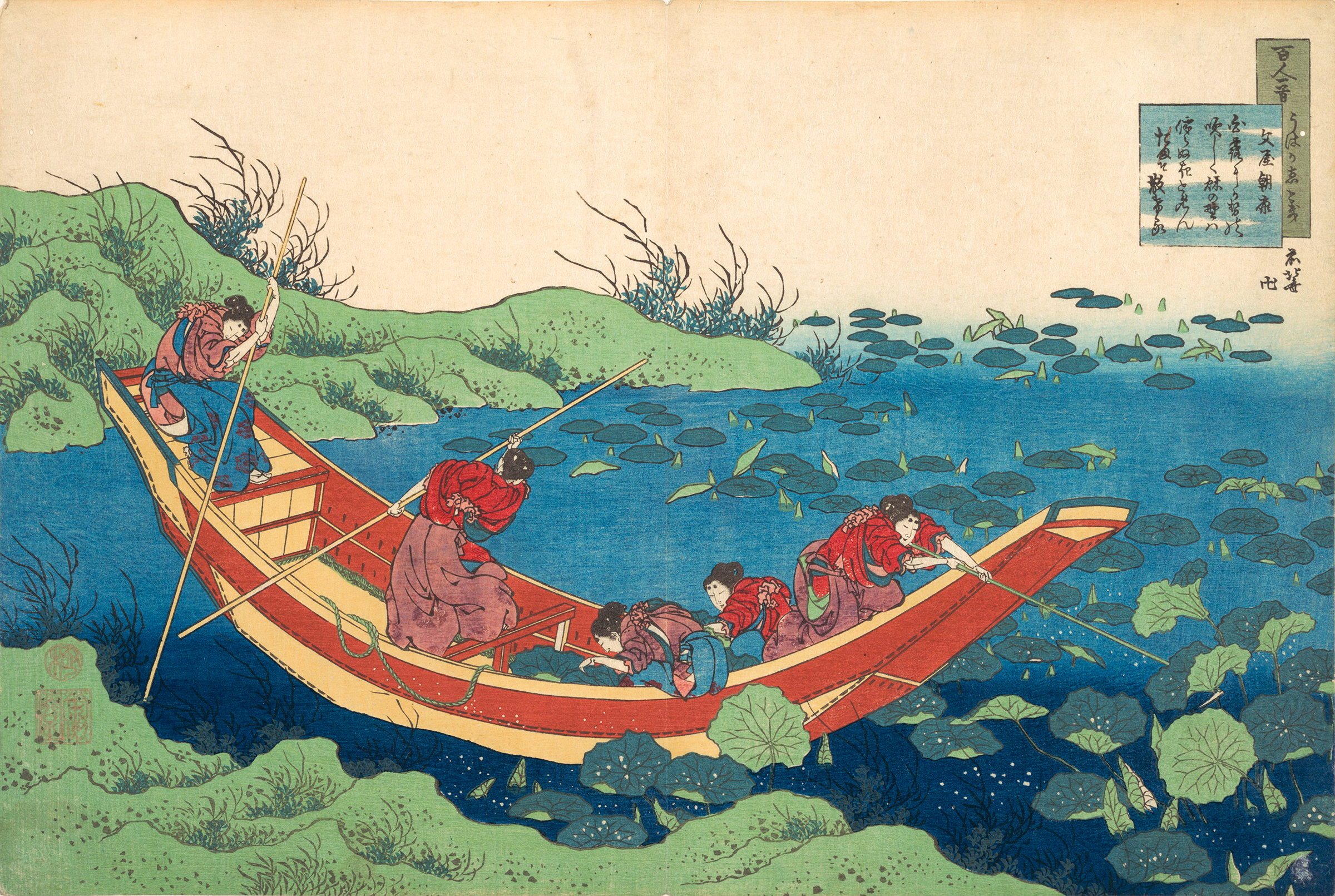
A final major series was begun c. 1835-36, the One Hundred Poems by One Hundred Poets, Explained by the Nurse. This series was loosely based on a famous compilation of 100 poems by Heian poets. Only 27 from this series were printed, though Hokusai clearly planned for 100 as 63 block-ready designs for this series are known (in museum collections).
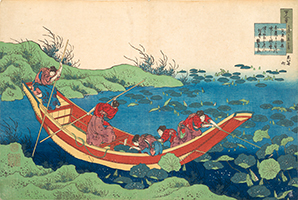
Poet Bunya no Asayasu
One Hundred Poems by 100 Poets Explained by the Nurse
By Hokusai, c. 1835-36
The MET, New York
The reason that a number of Hokusai’s print series from this period were not completed, and the reason that the third volume of One Hundred Views of Mount Fuji was not published until 1847, was economic. A famine in the years 1833-1837 resulted in thousands of deaths and caused rural revolts and urban riots. By 1836-37 things had become so bad in Edo that bodies were being left in the streets. Publishers stopped issuing new prints and some went bankrupt. Hokusai survived by putting together little books of paintings and selling them to wealthy patrons.
Following the famine, in 1839, Hokusai and O-Ei suffered a personal disaster when their home was destroyed by fire. Hokusai only had time to save his paint brushes. All other possessions including a large collection of reference sketches were lost. Following this fire Hokusai did not design any more print series. He devoted himself to painting.
Paintings
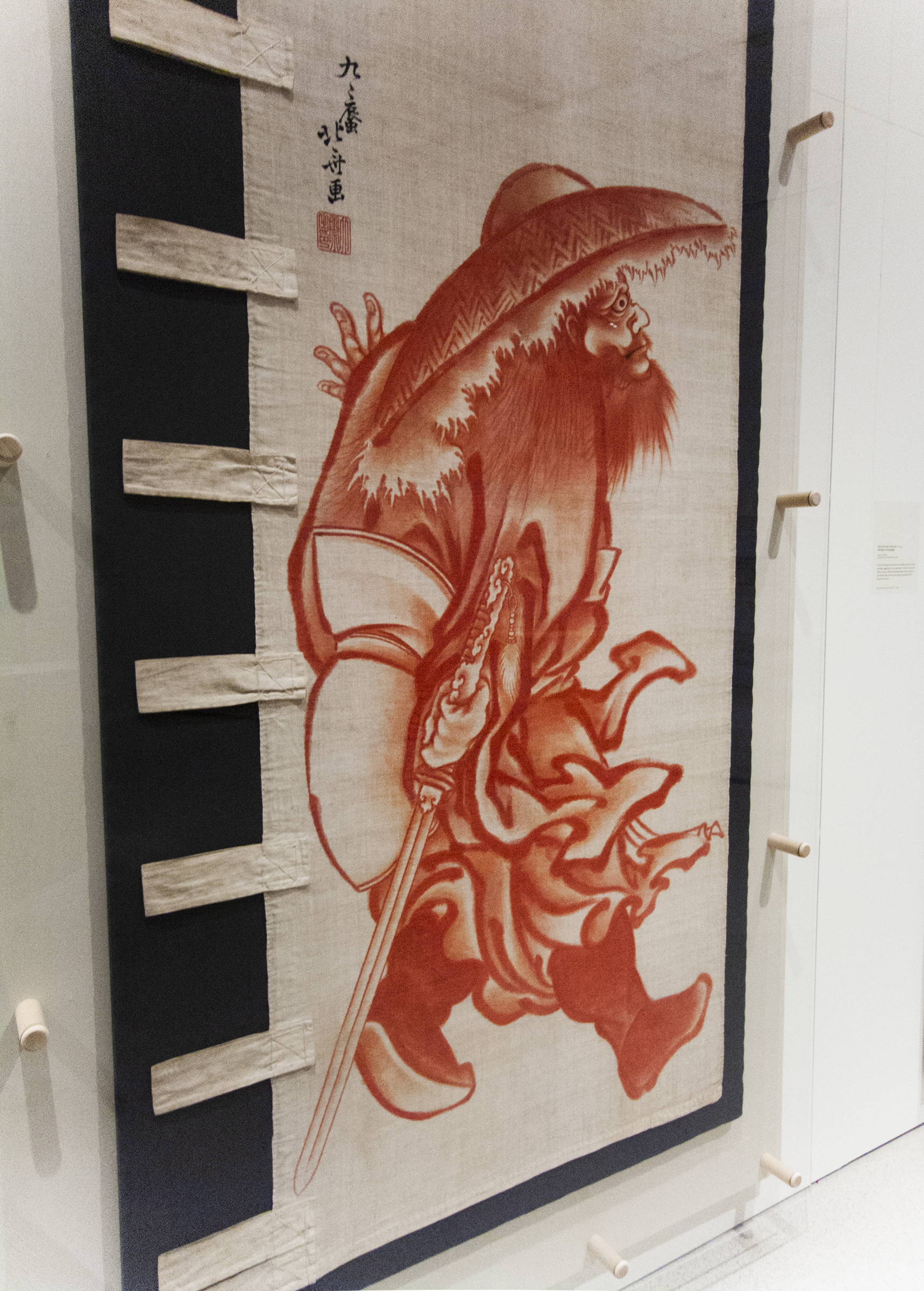
Hokusai had always, or at least from the later 18th century, been a painter. He painted the full range of things that might have been painted at that time, including utilitarian objects like fans and banners.
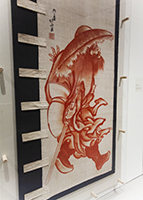
Boys Day banner: Shoki the Demon Queller
Signed Kukushin Hokusai, c. 1805
On display at the ROM, 2007
Property of the Museum of Fine Arts, Boston
Many of the things painted by Hokusai would have been destroyed either through use or by the many fires and other disasters that Edo/Tokyo has been subjected to over the years, but thanks to one devoted student some extraordinary paintings have survived in a town called Obuse.
Takai Kozan (1806-1883) came from Obuse, a village near Nagano in the mountainous region of central Honshu at least 300 km from Edo. The Takai family had a successful sake brewing business. Kozan was sent to Kyoto in 1820 to study Japanese, Chinese and Western learning. He composed poetry and practiced calligraphy and painting. In 1833 he travelled to Edo to study neo-Confucianism. It is not known whether Kozan met Hokusai by accident, or sought him out, but they became acquainted.
Kozan invited Hokusai to Obuse so that he could study with him. He had an art studio built for him there and he helped in finding commissions for him. Obuse is around 300 km. from Edo.
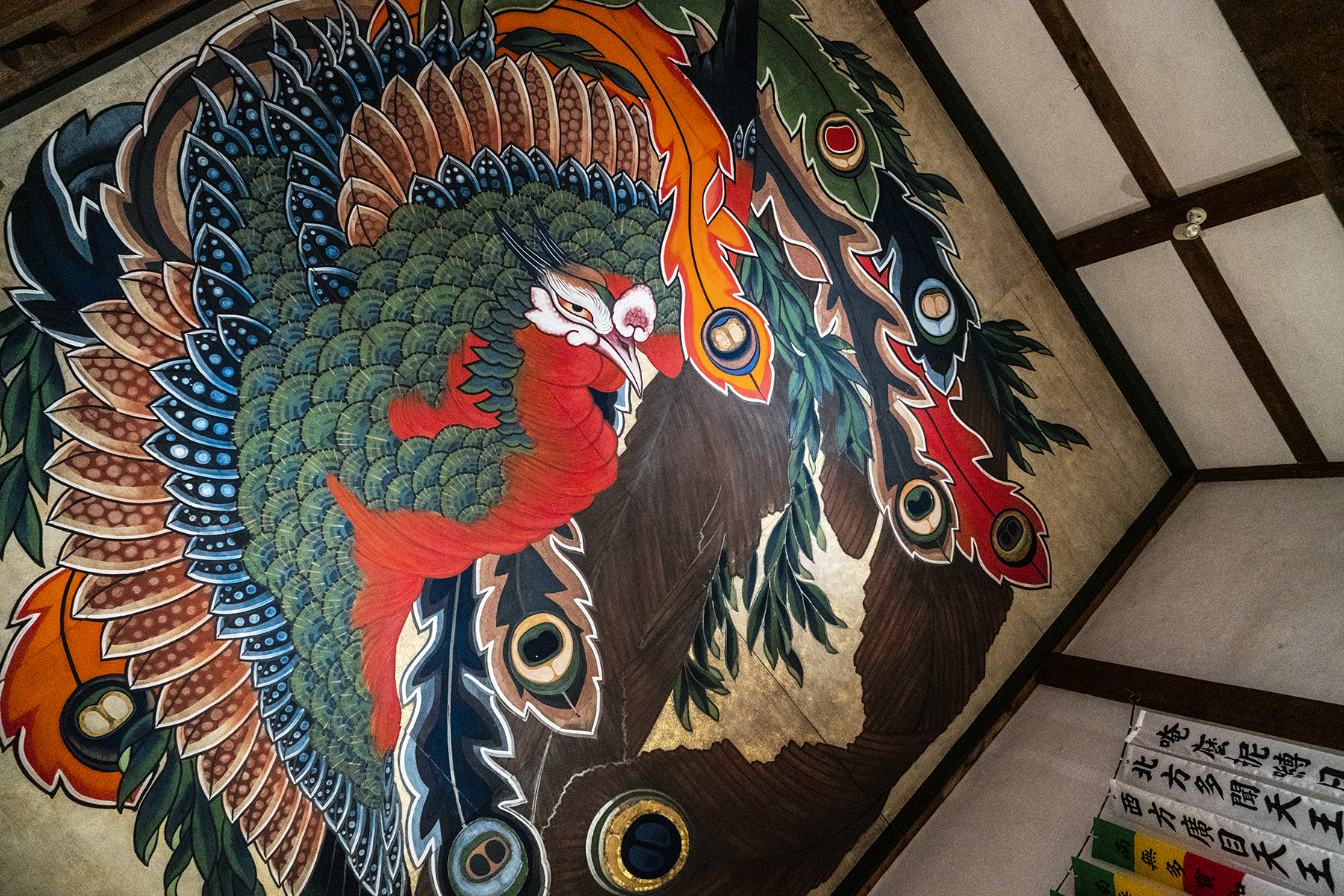
Between 1842-45 Hokusai visited several times, spending much time there. He painted panels for floats and he painted a phoenix on the ceiling of the main hall at Gansho-in Temple. That work is believed to be the largest extant painting by Hokusai. The phoenix painting is 6.3 meters by 5.4 meters.
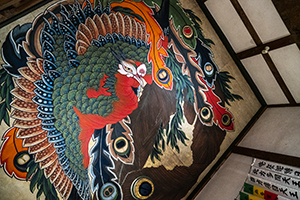
Phoenix by Hokusai
on the ceiling of the main hall at Gansho-in Temple
c.1843, Obuse
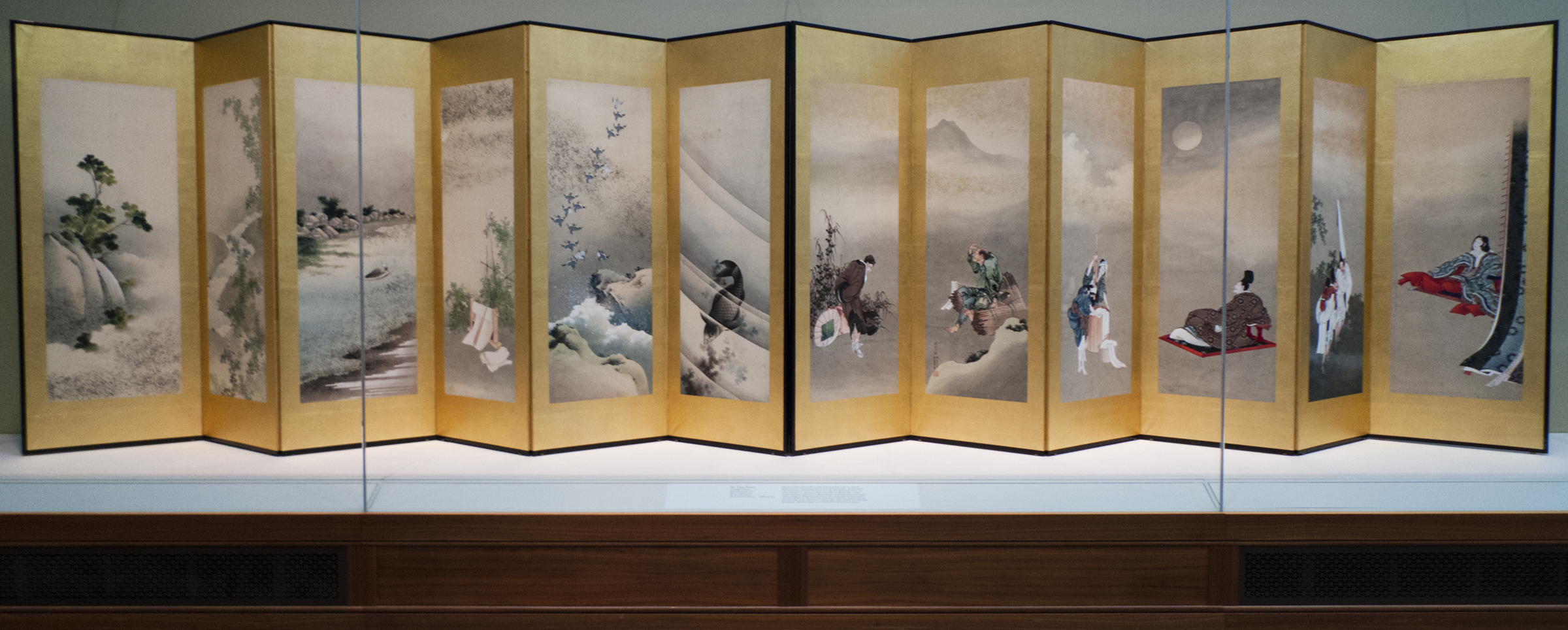
Naturally Hokusai also painted the same sorts of things that had been painted since the Heian times: emakimono (handscrolls), hanging scrolls, fusuma (sliding doors) and byobu (folding screens). His clients would have mostly been wealthy merchants like Kozan.
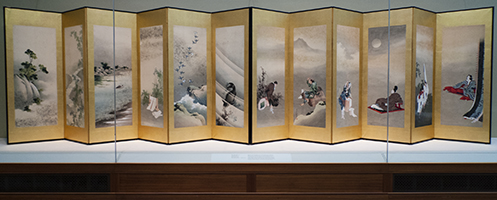
Six Tama Rivers (The Ide, the Noji, the Noda, the Koya, the Chofu, the Mishima)
Pair of 6-panel screens (byobu), By Katsushika Hokusai, 1833
The Freer Gallery of Art, Washington
The majority of known Hokusai paintings are from his later years. By this time he was devoting himself mostly to painting, and there were people in Edo actively collecting Hokusai paintings. He was famous, probably for both his artwork and his longevity, and by the end of his life his work was not only admired, but probably also seen as an investment.
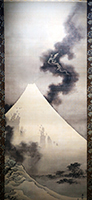
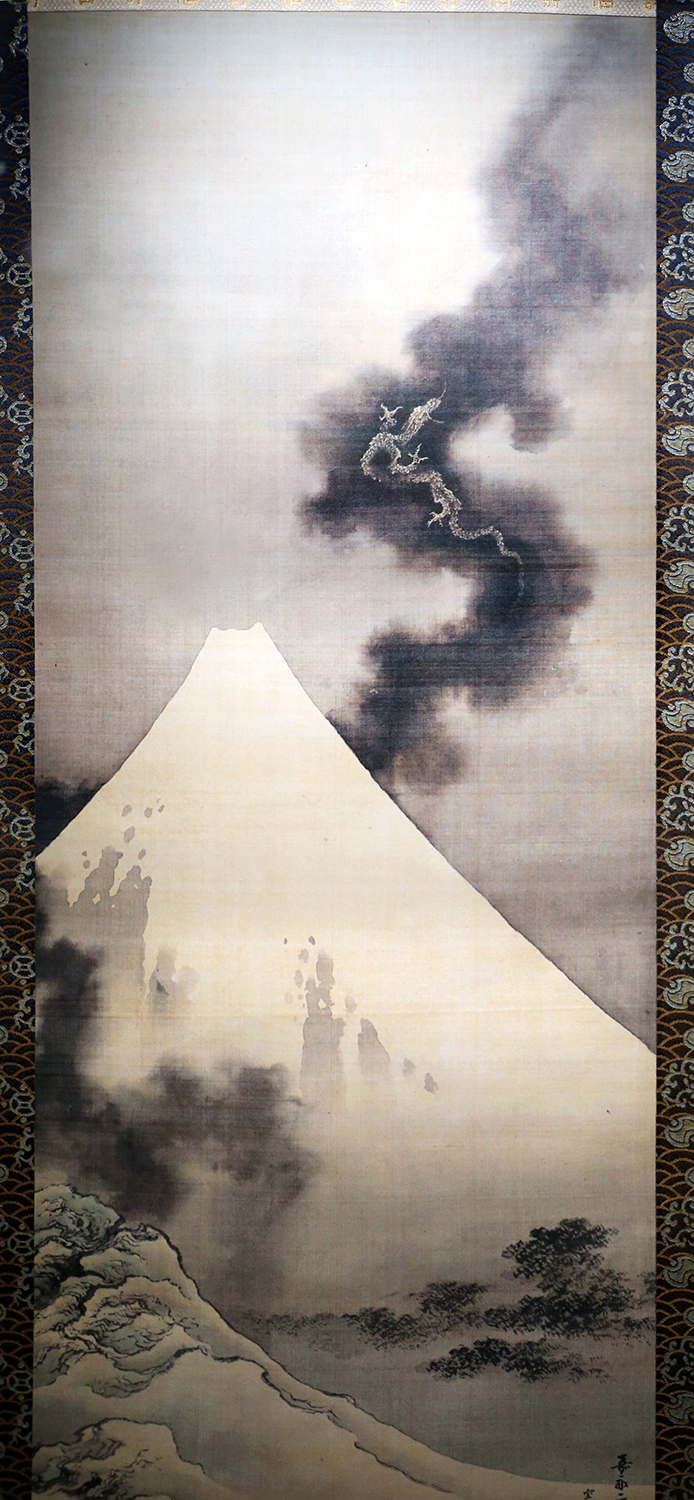
Dragon Rising above Mount Fuji
Signed Manji, old man of 90, born in dragon year
painted on dragon day, 1st month 1849
The Sumida Hokusai Museum, Tokyo
It is thought that Hokusai lived with his daughter O-Ei (also called Eijo or Oi) from 1828 until his death in 1849.
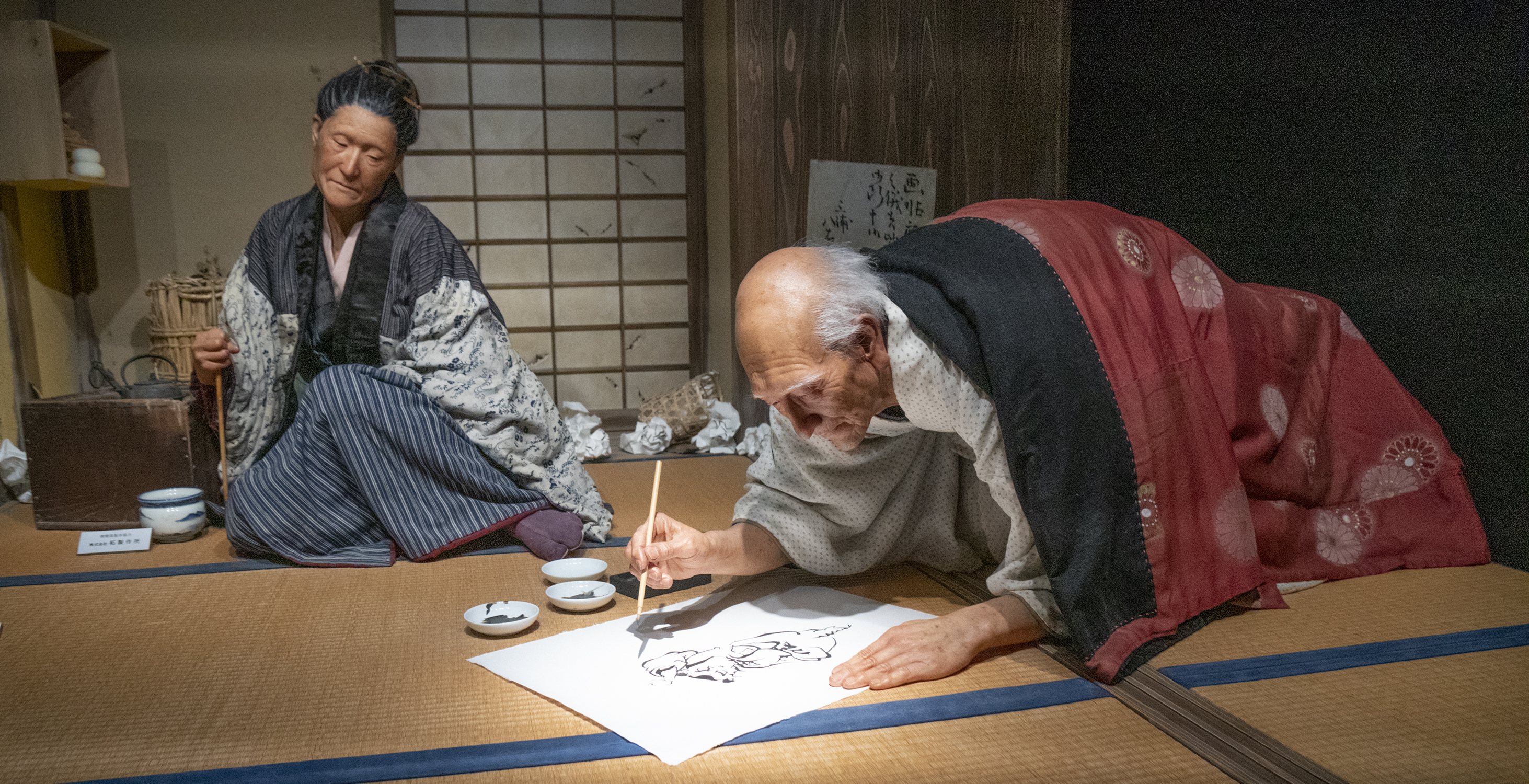
In the 1880s one of Hokusai’s students, Tsuyuki Iitsu II (died 1893), sketched O-Ei and Hokusai, showing them at home in the 1840s, for a writer who was preparing a biography of Hokusai. Hokusai is under a quilt, painting, with O-Ei watching. The notice on the wall reads “Absolutely no commissions for albums or fan paintings”.
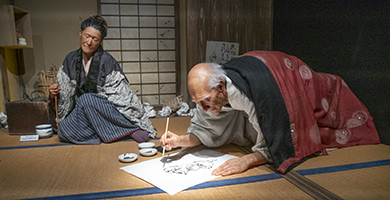
Life-size model of Hokusai and O-Ei based on the drawing by Tsuyuki Iitsu II
In the Sumida Hokusai Museum, Tokyo
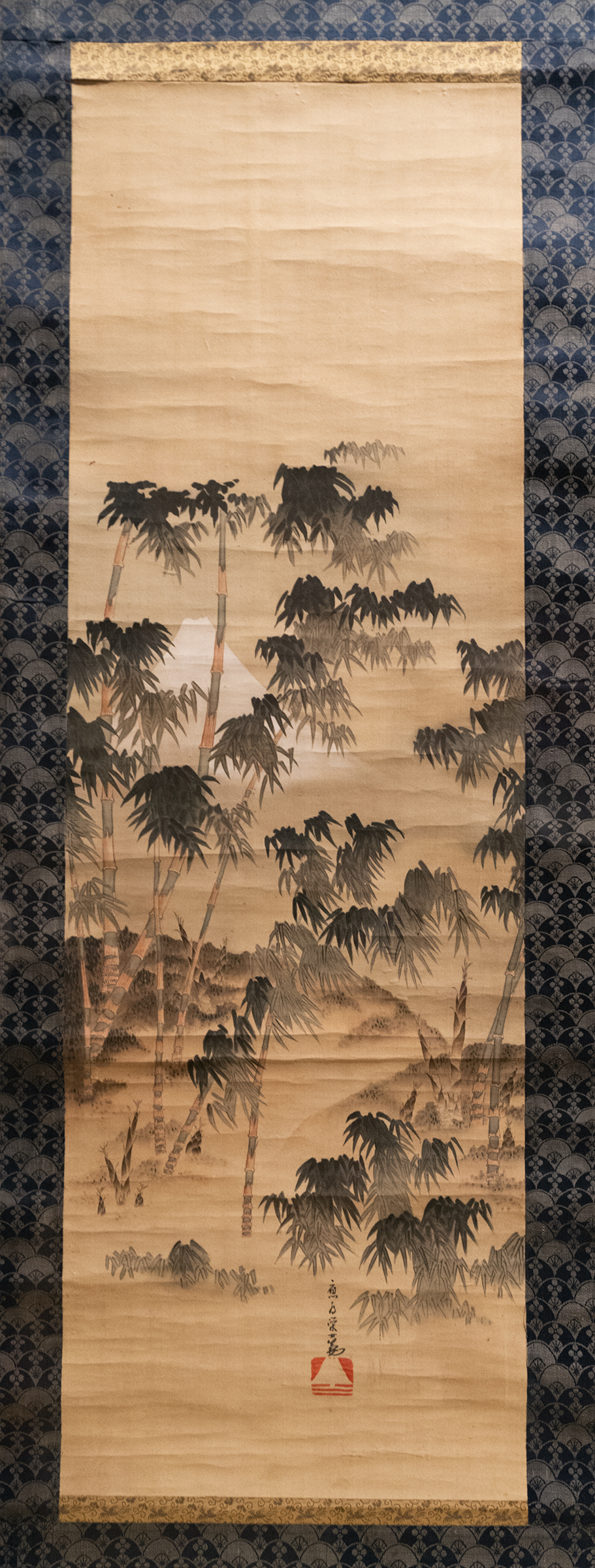
It is thought that O-Ei was both a painter and designer of woodblock prints, though I do not know of any prints that are signed by her. Some erotic designs (which were not signed) are attributed to her. There do exist a small number of paintings with her signature.
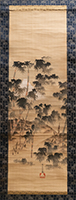
Fuji seen over the Bamboo Grove
By Katsushika Oi
Hokusai Museum, Obuse